Most parents don't think twice about who they're renting from. They Google "bounce house rental near me," click the first result, check that the price seems reasonable, and book it. And most of the time, that works out fine.
But not always.
I've heard enough stories — and had enough of my own minor headaches with rentals — to know that the company you choose matters more than most people realize. A bad rental experience isn't just a disappointment. It can mean a no-show on your kid's birthday, an uninsured setup in your backyard, or a unit that smells like it hasn't been cleaned since 2019.
The good news is that vetting a rental company takes about ten minutes if you know what to look for. Here's exactly what I check before booking.
Start With Insurance — It's Non-Negotiable
This is the first thing I ask about, every single time. A legitimate rental company carries general liability insurance — at minimum $1 million per occurrence is the industry standard, and many venues and parks require it before they'll allow a setup on their property.
Why does this matter to you as a renter? Because if something goes wrong — a child gets hurt, equipment damages your property, anything — an uninsured company leaves you and your homeowner's insurance holding the bag. That's not a position you want to be in.
What to do: Simply ask. "Can you send me a copy of your certificate of insurance?" A reputable company will have one ready and will send it without hesitation. Any company that hedges, deflects, or tells you they're "in the process of getting it" should be crossed off your list immediately.
A few states — Texas and Florida among them — have specific regulatory requirements for bounce house rental operators, including mandatory inspections and minimum coverage amounts. If you're in one of those states, it's worth asking whether the company is state-certified in addition to being insured. A company operating in Texas, for instance, is required by the state to carry at least $1 million in bodily injury coverage and $500,000 for property damage, and to pass annual safety inspections.
Ask About Their Cleaning Process — Specifically
Every rental company will tell you they clean their units. What separates the good ones from the bad ones is whether they can tell you how.
A thorough cleaning process involves two stages: dry cleaning first (vacuuming out debris, dirt, and anything kids left behind), followed by wet cleaning with a disinfectant appropriate for vinyl surfaces, and then complete drying before the unit is packed up. Skipping the drying step is where mold problems start — and a moldy bounce house is not something you want your kids playing in.
When you ask, listen for specifics. "We wipe them down after every rental" is a vague non-answer. "We vacuum first, then disinfect with [specific product], let it air dry completely, and inspect before packing" tells you they actually have a process. The detail in the answer is what matters.
It's also worth asking whether their units are ASTM F2374-22 compliant — that's the industry safety standard for inflatable amusement devices. And if the company is SIOTO certified (Safe Inflatable Operators Training Organization), that's a genuine signal they take the professional side of this seriously. Most casual operators won't know what either of those acronyms means, which is itself useful information.
Check Their Equipment Age and Condition
Commercial bounce houses used heavily can show real wear within a few years — seam stress, fading, patched tears, weakened anchor points. A well-maintained unit from a quality company can last much longer, but only if they're actually maintaining it.
You can't always inspect a unit before it arrives, but you can ask: "How old is the unit you'd be delivering for my event?" and "Can you show me photos of the specific unit?" Reputable companies photograph their inventory and can pull up current images. If they can only show you stock photos from the manufacturer, that's not reassuring.
When the unit does arrive, take a quick look before the kids pile in. Check for obvious tears, heavily patched areas, or anything that looks structurally compromised. A reputable company won't be offended by a parent doing a quick visual — they should welcome it.
Understand Their Setup and Anchoring Practices
An improperly anchored bounce house is genuinely dangerous. Wind is the main risk — most manufacturers recommend removing children and deflating when winds exceed 15 mph. An inflatable that isn't properly staked or weighted can become airborne in a gust, with catastrophic consequences.
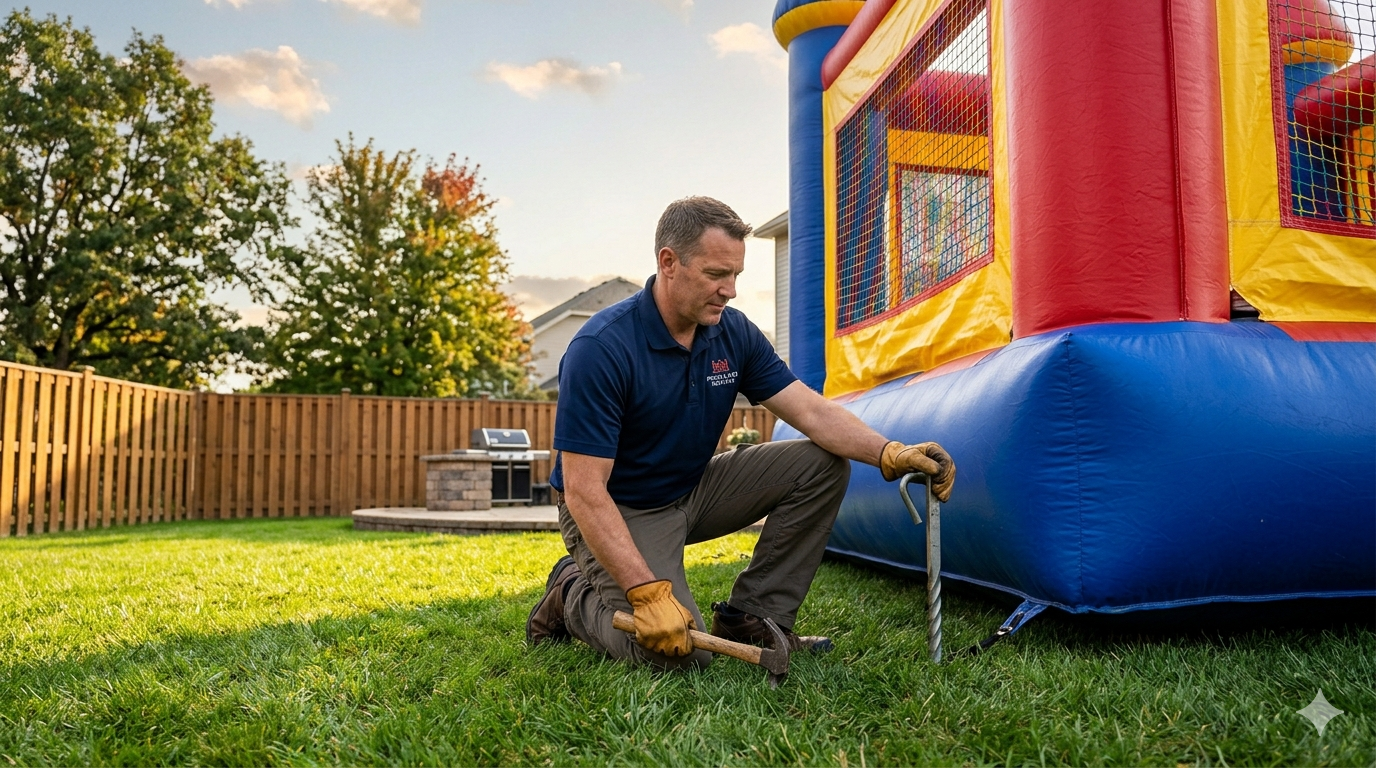
A good company sets up the unit themselves, anchors it properly with stakes or sandbags appropriate for the surface, and walks you through the safety basics before they leave. A company that drops the unit in your driveway and hands you a blower is cutting corners on the part of the process that matters most for safety.
Ask upfront: "Do you handle full setup and anchoring, or is that on me?" Full-service setup should be standard. If they're charging extra for it, that's worth knowing before you compare prices.
Understand the Cancellation Policy — On Both Sides
This is something I learned the hard way. Know what happens if you need to cancel, and know what conditions allow them to cancel on you.
Most companies require a deposit (typically $50-$100, sometimes up to 50% of the rental total) that is non-refundable if you cancel within a certain window — usually 7-14 days of the event. That's reasonable and standard. What you want to avoid is a company that keeps your full deposit for a cancellation you made weeks out.
More importantly: understand their weather cancellation policy. I once had a company cancel on me because of a "chance of rain" in the forecast — it turned out to be a beautiful day. Some companies are overly conservative about weather cancellations because it protects their equipment. Find out what specific conditions trigger their right to cancel, and what happens to your payment when they do. A raincheck valid for one year is a fair outcome; a forfeited deposit for a company-initiated cancellation is not.
Read the Reviews — The Right Way
Online reviews are useful, but you have to read them with some judgment. Here's what I actually look for:
Volume and recency matter more than rating. A company with 4.6 stars and 200 reviews over three years tells me much more than one with 5 stars and 8 reviews. Recent reviews — from the past 6-12 months — are most relevant, since staff and ownership can change.
Look for how they handle negative reviews. Every company gets a bad review occasionally. What matters is whether they respond professionally and try to resolve the issue, or whether they get defensive and combative. The response to a bad review tells you more about a company's character than the review itself.
Watch for reviews that mention specific problems. Late delivery, dirty units, and no-shows are the three most common complaints in bounce house rental reviews. If you see more than one or two of any of these across a company's reviews, take it seriously.
The Red Flags — Things That Should Send You Elsewhere
A few things that, in my experience, reliably indicate a company not worth your money or your trust:
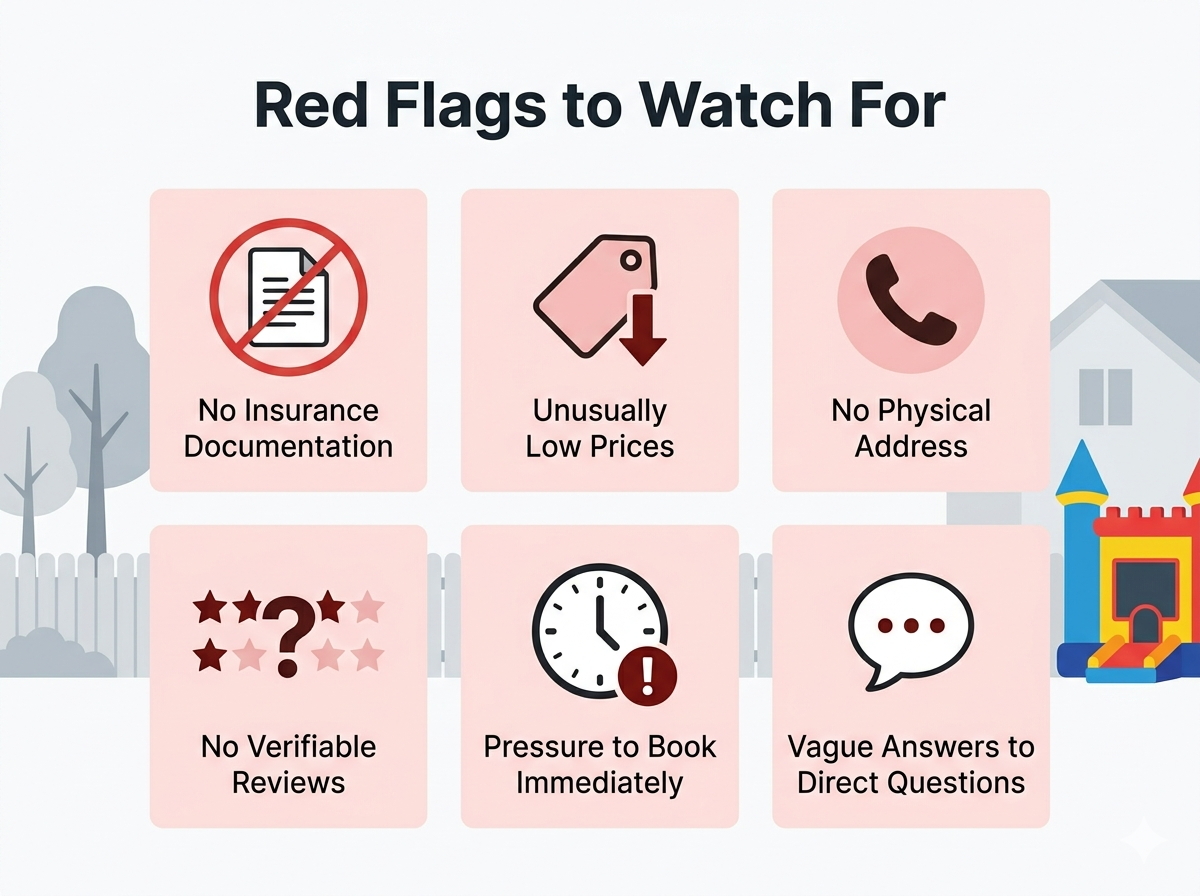
No website, no Google Business listing, social media only. Fly-by-night operators frequently set up Facebook or Instagram pages and disappear after a season. A company with an established web presence and verified Google reviews has more accountability.
Unusually low prices. If one company is quoting $90 when everyone else is at $200, something is off. Either they're uninsured, their equipment is in poor condition, or they're planning to no-show and keep your deposit. All three happen more than you'd think.
Reluctance to provide insurance documentation. As I mentioned above, this is a dealbreaker. No legitimate company should hesitate to share a certificate of insurance.
Vague or evasive answers to direct questions. If you ask "how do you clean your units?" and the answer is "oh, we take care of all that," you haven't actually learned anything. A good company has real processes and isn't shy about describing them.
No physical address or contact information beyond a cell number. If the company has no verifiable location and the only way to reach them is one phone number, that's a risk.
Pressure to book immediately. "This slot is going fast, I need a deposit today" is a sales tactic, not a reason to skip due diligence. Good companies have availability and don't need to rush you.
The Questions to Ask Before You Book
Here's the shortlist I'd run through with any company before handing over a deposit. Screenshot this for your next rental search:
| Question | What a Good Answer Looks Like |
|---|---|
| Are you insured? Can you send me your COI? | "Yes, absolutely — here it is." Sent promptly, no hedging. |
| How do you clean your units between rentals? | Specific process: vacuum, disinfect, dry fully. Not just "we wipe them down." |
| Do you handle full setup and anchoring? | "Yes, our crew handles everything." Setup should be included, not an upsell. |
| What's your weather cancellation policy? | Specific wind/rain thresholds. Clear policy on what happens to your payment. |
| What's the all-in price delivered to my address? | A single number that includes delivery, setup, and any fees. No surprises. |
| Can you show me photos of the specific unit? | Current photos of actual inventory, not manufacturer stock images. |
| How far in advance do I need to book? | Honest answer about their availability and lead time requirements. |
You don't need to ask all of these on a single call — but if a company gives you a bad answer to any of the first three, the rest of the conversation probably doesn't matter.
One More Thing: Setup vs. Drop-Off Rentals
Some rental companies — especially at the budget end of the market — operate on a drop-off model: they deliver the deflated unit, you inflate and set it up yourself, and you return it yourself. The price is usually lower, but so is everything else: no professional anchoring, no safety walkthrough, and the full physical burden of setup and takedown is on you.
I talked about this in detail in my rental checklist article — commercial rental units are genuinely heavy and awkward, and self-setup is harder than it sounds. For most families, full-service delivery is worth the premium. At minimum, go in with open eyes about what you're signing up for if you take the drop-off route.
The Bottom Line
The vast majority of bounce house rentals go off without a hitch, and most rental companies are decent operations run by people who care about their reputation. But the ones that aren't can ruin a party and, in rare cases, create real safety issues.
Ten minutes of due diligence — insurance documentation, a direct conversation about cleaning, a quick review scan — is all it takes to separate the good companies from the ones worth avoiding. Your kids' party is worth that ten minutes.