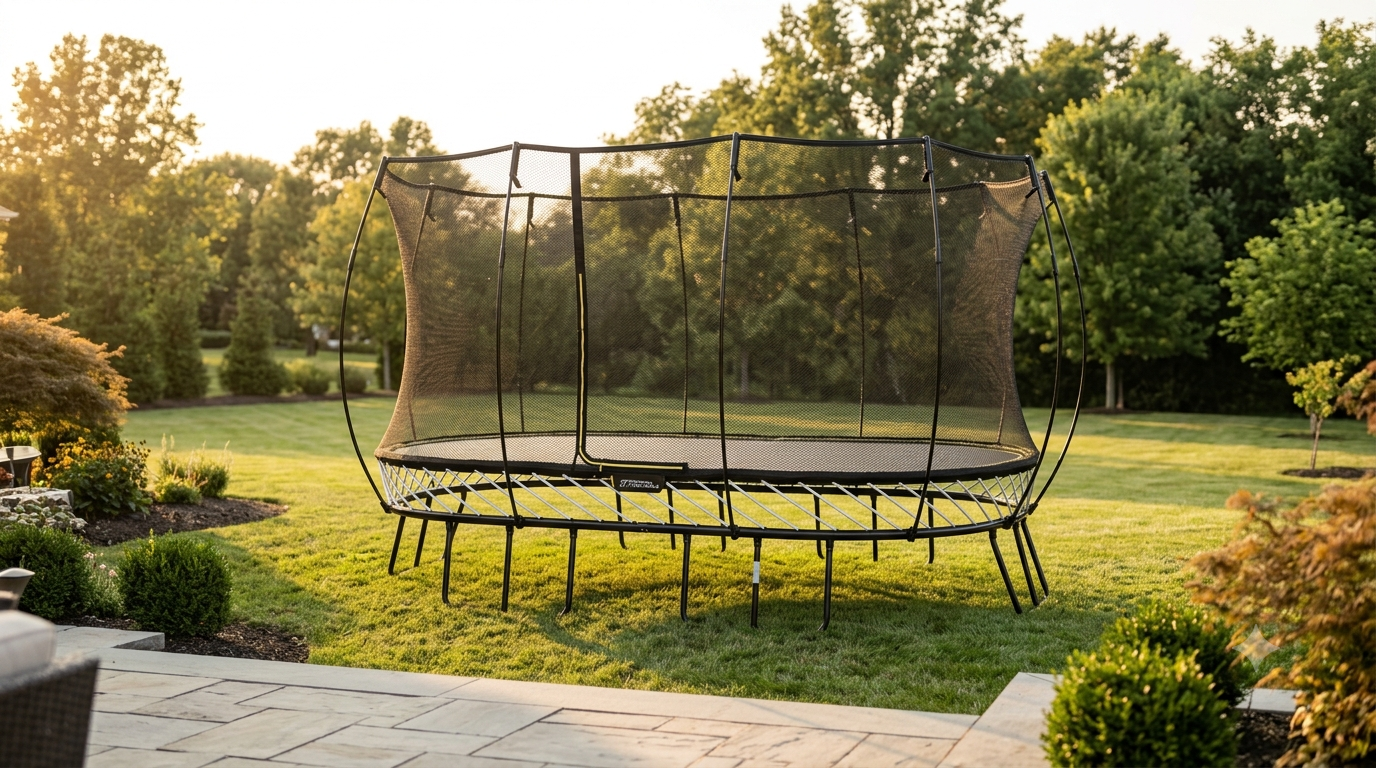
There's a moment every trampoline-owning family hits: the entry-level unit you bought when your kids were 6 is now hosting three teenagers at once, the mat has gone slack in the middle, and you're eyeing something bigger and sturdier. This guide is for that moment. I'm not covering budget starter trampolines here — I've got a separate trampoline brands guide for that. This one is specifically about what to buy when you're ready to spend real money on something built to handle bigger kids, more of them, and more years of daily use.
The best large and premium trampolines are...
![Best Trampoline Brands for Your Family [2026]](/images/posts/best-trampoline-brands.png "Best Trampoline Brands for Your Family [2026]")
I get some version of this question almost as often as the bounce house one: "Which trampoline brand should I actually buy?" And honestly, the stakes are a little higher with trampolines than with bounce houses, because a trampoline isn't something you inflate for an afternoon and put away — it sits in your yard, in the sun and rain, for years. The brand you pick determines whether that frame is still solid in year eight or rusting through by year three.
Quick answer: If you want the best trampoline money can buy and you're not counting pennies, get a
The honest truth is that trampolines have a much wider quality spread than bounce houses do. A cheap trampoline doesn't just wear out faster — a frame that rusts through or springs that fatigue unevenly is a real safety issue, not just an inconvenience. So this list leans a little more heavily on warranty terms, certifications, and materials than my other brand guides do.
![The Most Unique Bounce Houses for Themed Parties and Events [2026]](/images/posts/most-unique-bounce-houses-for-themed-parties-events.png "The Most Unique Bounce Houses for Themed Parties and Events [2026]")
Every few months I get the same message from a parent planning a big birthday: "We want to do a theme, but every bounce house on Amazon just looks like every other bounce house." I get it. Scroll through generic search results and you'll see a hundred nearly identical castle bouncers with slightly different clip art. Finding one that actually commits to a theme — a real pirate ship silhouette, a real dinosaur sculpture, real turrets instead of a printed castle backdrop — takes some digging.
Quick answer: If you want the single most theme-committed option on this list, it's the
I went through and verified every product below is a real, currently listed item on Amazon — not a stock photo or a discontinued listing. I organized them by theme, noted the price tier, and called out which ones are worth the upgrade versus which ones are fine as an entry-level pick. As always, my audience here tends to have a bit more room in the budget, so I've leaned toward units with better materials and more realistic theming rather than the cheapest possible option in each category.
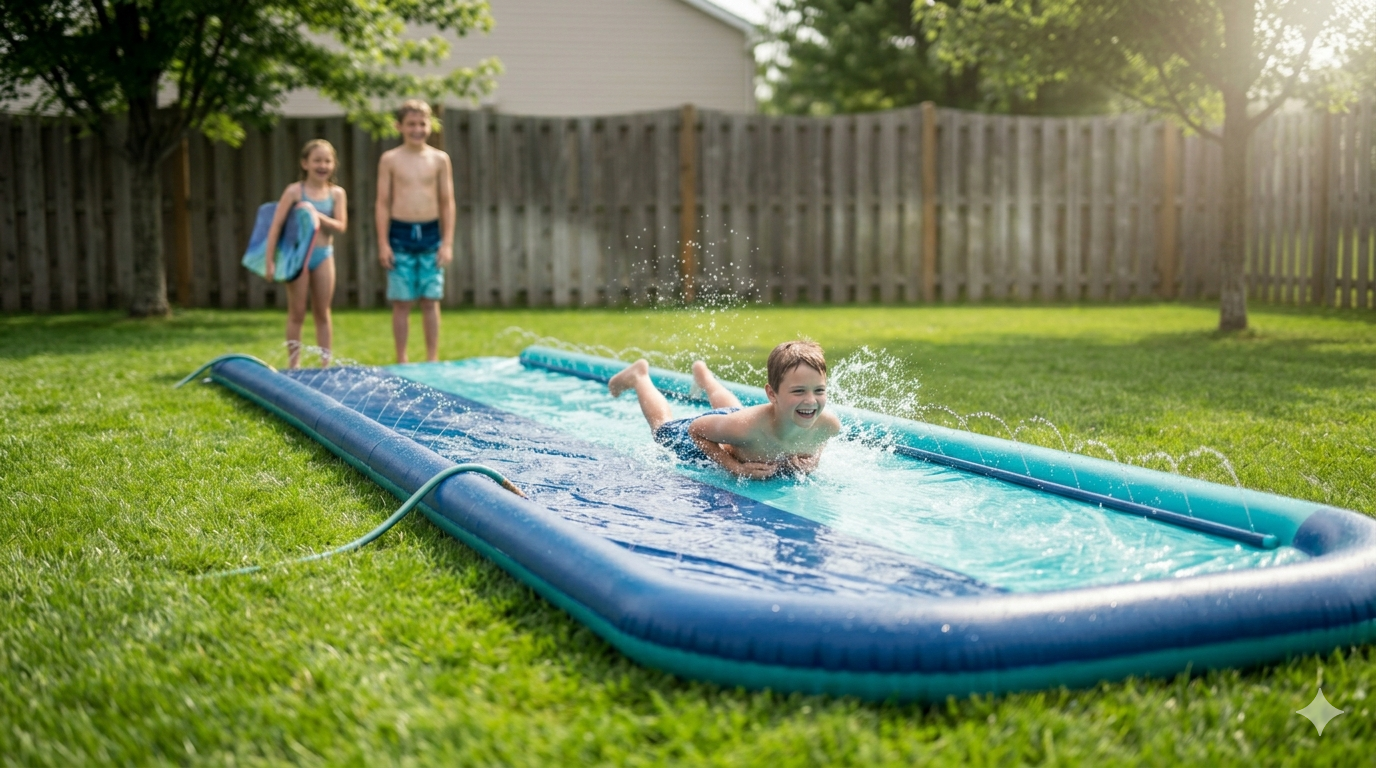
There is no simpler formula for a perfect summer afternoon than a long strip of wet plastic, a running start, and a yard full of kids. Slip and slides have been doing exactly that since Wham-O introduced the original in 1961, and more than six decades later the category has exploded into a legitimate market with options ranging from a basic $20 lawn slide to a 75-foot commercial-grade monster that takes over your entire backyard.
I've been writing about backyard inflatables for years, and the slip and slide category is one where the buying decision is deceptively tricky. Size matters enormously — but so does material thickness, sprinkler design, crash pad quality, and whether the staking system is going to rip your slide on day one. I've sorted through all of it so you don't have to.
Here are the best backyard slip and slides for every age, yard size, and budget:
![Bounce House Age Guide: What Size and Type Is Right for Your Kid? [2026]](/images/posts/bounce-house-age-guide.png "Bounce House Age Guide: What Size and Type Is Right for Your Kid? [2026]")
"What age is a bounce house for?" is one of the most common questions I get, and the honest answer is: it depends a lot more on the specific unit than people expect. A bounce house that's perfect for a 3-year-old can be genuinely unsafe for a 9-year-old to use at the same time, and a unit built for a backyard birthday party of 8-year-olds will bore a toddler in about ninety seconds.
This guide breaks bounce houses down by age, explains what actually matters at each stage (it's not just age — weight limits, entry height, and wall design all factor in), and points you toward specific units that are genuinely well-suited for each age range.
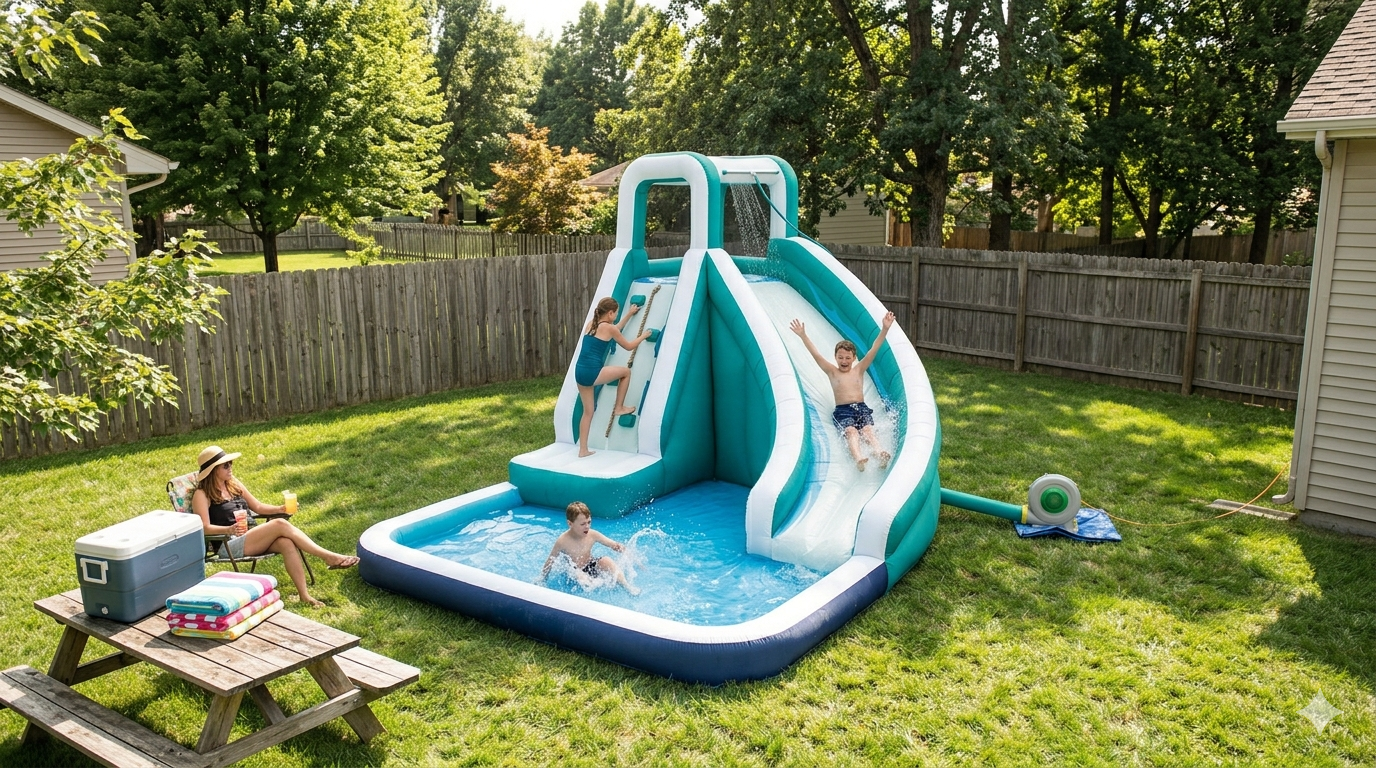
There's a difference between buying a water slide and building a backyard water park. A water slide is one inflatable that does one thing well. A water park is an experience — the right unit, the right setup, the right accessories, and a yard that's actually prepared for a full day of kids running, climbing, and splashing without anyone getting hurt or anything getting ruined.
I get a lot of questions from readers who bought a big multi-feature inflatable, set it up wrong, and ended up with a flat tire instead of a water park — a blower that couldn't keep up, anchors that pulled loose, a yard that turned into a mud pit by 2pm. This guide is meant to solve that. We'll cover which unit to buy, what accessories you actually need (and which ones are skippable), and exactly how to set the whole thing up so it survives the whole summer.
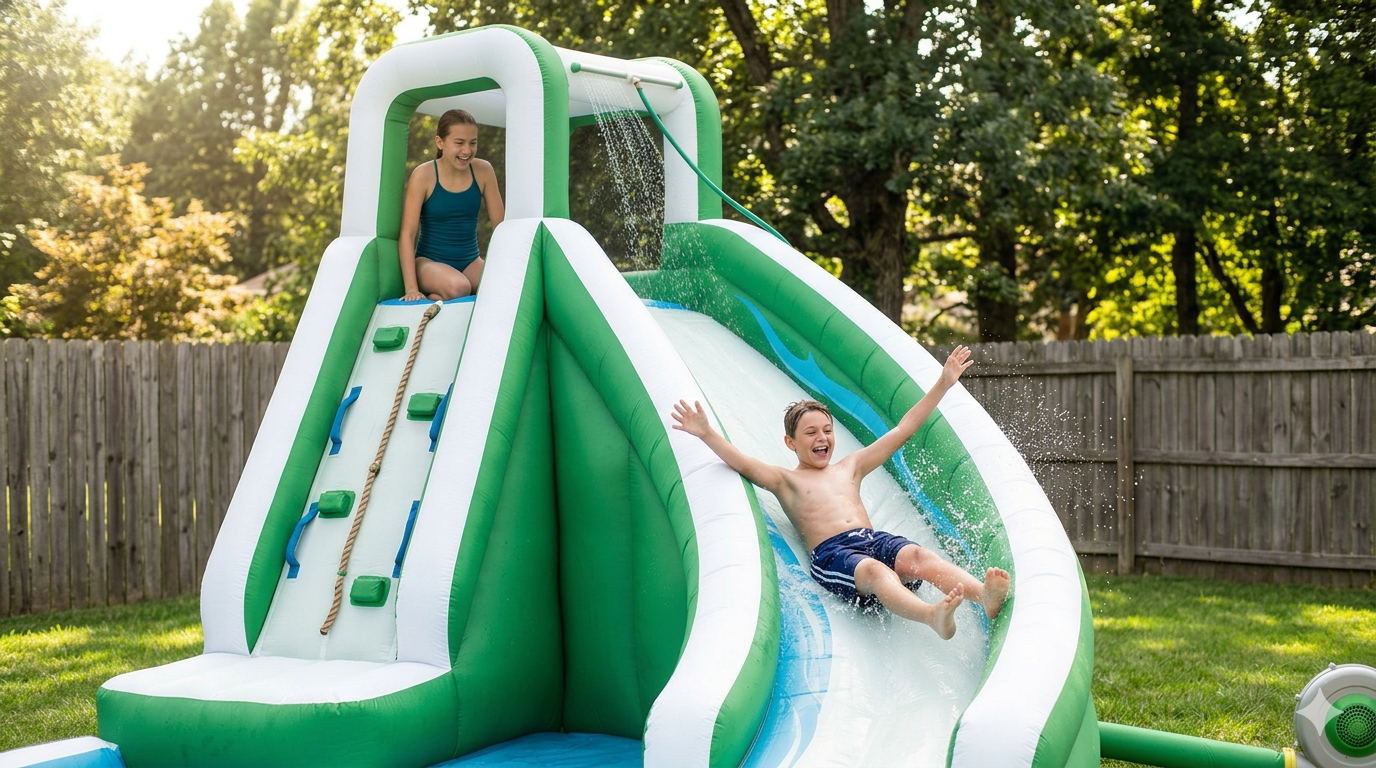
Most inflatable water slides are designed for kids under 10. The slides are short, the weight limits are low, and a 12-year-old riding one looks approximately as thrilling as going down a parking garage ramp. If you have older kids, teens, or adults who want in on the fun, you need something bigger — and the difference between a 7-foot slide and a 12-foot slide is not subtle.
I've been tracking this category for years, and the good news is that the options for big kids have gotten significantly better. The bad news is that the market is flooded with oversized, overpromised units that look impressive in the listing photos and disappoint in the backyard. This guide cuts through all of that.
Here are the best inflatable water slides for older kids, teens, and adults:
![Bounce House vs. Trampoline: Which Is Right for Your Family? [2026]](/images/posts/bounce-house-vs-trampoline.png "Bounce House vs. Trampoline: Which Is Right for Your Family? [2026]")
At least once a week I get a version of this question: "We're trying to decide between a bounce house and a trampoline — what do you recommend?" It's a great question, and unlike a lot of product comparison questions, it doesn't have a universal answer. The right choice depends on your kids' ages, your yard, your budget, and honestly, what kind of play experience you're trying to create.
What I do have is data. I've been tracking sales and returns on both categories as an Amazon affiliate since 2016. I know what sells, what gets returned, what families keep for years, and what ends up deflated in the garage by September. That perspective shapes every recommendation in this guide.
The short version: If your kids are under 8 and you want something versatile for parties and playdates, get a
![The Best Commercial-Grade Bounce House for Home Use [2026]](/images/posts/best-commercial-grade-bounce-house-home.png "The Best Commercial-Grade Bounce House for Home Use [2026]")
Let me tell you about a pattern I've noticed in nearly a decade of tracking bounce house sales and returns. A family buys a residential bounce house for $250. They love it. The kids use it hard. It survives a season, maybe two. Then something gives — a seam splits, the bounce floor thins, the blower labors — and they're back on Amazon shopping again. Three years later they've spent $600 replacing a product they thought they were buying once.
The families who avoid that cycle almost always share one thing: they bought commercial-grade from the start.
The short version: If you're serious about buying once and never replacing it, start with the
But first, let me explain what "commercial grade" actually means. Because it's one of the most abused terms in this category, and understanding the real definition is the difference between a smart purchase and an expensive mistake.
![The Best Inflatable Obstacle Course for Your Backyard [2026]](/images/best-inflatable-obstacle-course-for-backyard.png "The Best Inflatable Obstacle Course for Your Backyard [2026]")
I want to tell you something I've noticed after years of tracking what families actually buy — and more importantly, what they keep.
Bounce houses get set up a few times a season. Inflatable obstacle courses get set up every single weekend. There is something about a course — the competition, the physical challenge, the "one more time" energy — that keeps kids coming back in a way that a standard bounce house just doesn't. Once a family discovers this, they almost never go back.
My top pick: The
But first, let me walk you through what actually matters when shopping in this category, because the decisions you make here are different from buying a standard bounce house.