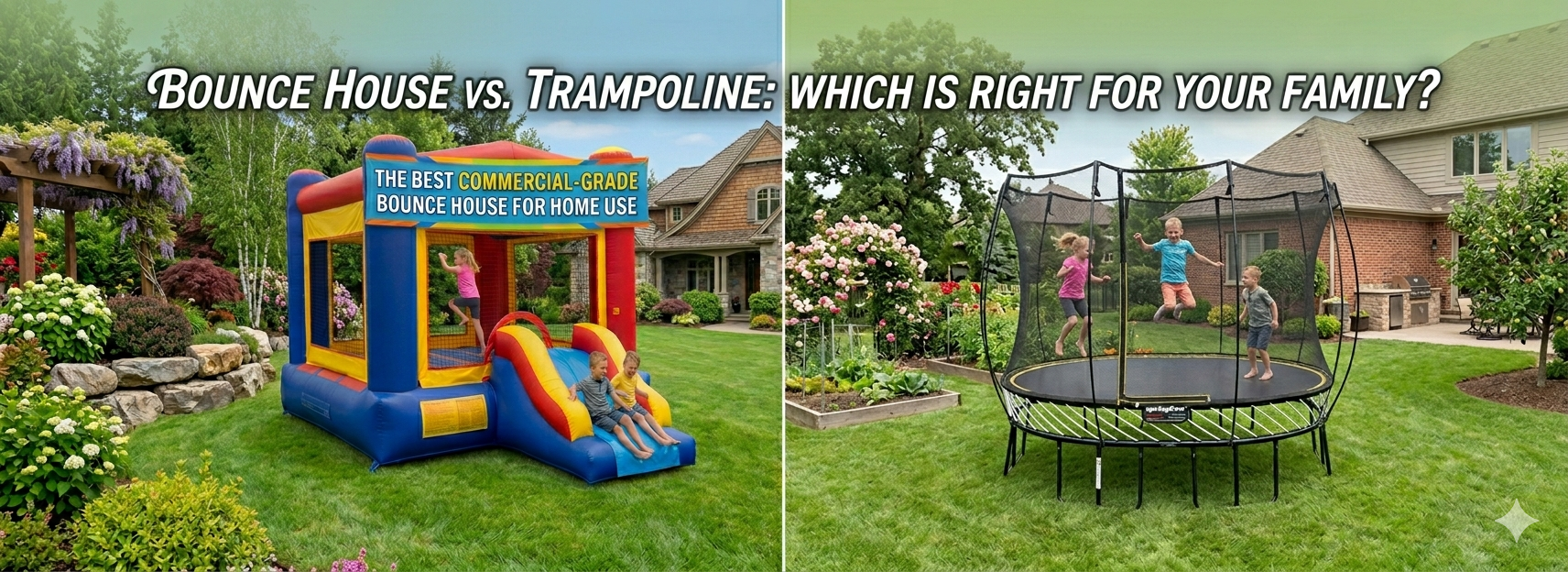
At least once a week I get a version of this question: "We're trying to decide between a bounce house and a trampoline — what do you recommend?" It's a great question, and unlike a lot of product comparison questions, it doesn't have a universal answer. The right choice depends on your kids' ages, your yard, your budget, and honestly, what kind of play experience you're trying to create.
What I do have is data. I've been tracking sales and returns on both categories as an Amazon affiliate since 2016. I know what sells, what gets returned, what families keep for years, and what ends up deflated in the garage by September. That perspective shapes every recommendation in this guide.
The short version: If your kids are under 8 and you want something versatile for parties and playdates, get a bounce house. If your kids are 8 and older and you want something they'll use independently every day, get a trampoline. If your budget and yard allow it — get both. I'll explain the reasoning below.
The Quick Comparison
| Bounce House | Trampoline | |
|---|---|---|
| Best age range | 2–10 years | 6 years and up |
| Price range | $150–$2,000+ | $80–$800+ |
| Setup | 5–15 min per use, stored away | One-time assembly, permanent fixture |
| Space required | Flexible — varies by unit size | Fixed — stays in one spot year-round |
| Party/group use | Excellent | Limited — one or two kids at a time |
| Daily independent use | Limited — requires adult setup | Excellent — always ready |
| Water play option | Yes — many combo units available | Limited — sprinkler attachments only |
| Storage | Requires garage/storage space | Stays outdoors year-round |
| Longevity | 3–10+ years (material dependent) | 5–15+ years (quality dependent) |
Cost: What Are You Actually Spending?
Both categories have wide price ranges, and the honest comparison isn't entry-level versus entry-level — it's what each product delivers at a given spend.
Bounce Houses
Entry-level bounce houses from Little Tikes and Cloud 9 start around $150–$250 for basic bouncers designed for young kids. Mid-range units from Blast Zone and Bounceland run $300–$600 and step up significantly in construction quality, size, and feature set. Commercial-grade units from TentandTable and Cloud 9's commercial line run $800–$2,000 and are built to outlast the childhood of whoever uses them.
The thing I always tell families is to think about total cost of ownership rather than purchase price. A $200 nylon bouncer that lasts two seasons costs $100 per year. A $600 Blast Zone unit that lasts eight seasons costs $75 per year. The math isn't complicated — but it requires resisting the entry-level price point in favor of the better long-term investment.
/primary/Blast Zone Superstar - Huge 12x15 Inflatable Bounce House - Pr (B0015DEDEK)_medium.jpg "Blast Zone Superstar - Inflatable Bounce House with Blower - Large - Premium Quality - Great For Events - Holds 6 Kids")
The units I'd point to at each price tier:
Under $300 — the Little Tikes Jump 'n Slide Bouncer for toddlers and young kids. Simple, reliable, sold everywhere.
$300–$600 — the Blast Zone Superstar is the unit I recommend most often at this range. Commercial-grade construction, two-year warranty, 500 lb capacity. The return rate in my data is about as low as I track for any bounce house at any price.
$600+ — the Blast Zone Pirate Bay if you want a full water park combo, or the Cloud 9 Commercial Castle if you want to buy once and never replace it.
Trampolines
Trampolines have a more compressed price range at the quality end. Entry-level mini trampolines for young kids start under $100. Standard backyard trampolines — 10 to 15 feet with safety enclosures — run $200–$500 for quality brands. Premium units with additional features like basketball hoops and higher weight ratings sit at $400–$800.
The key variable with trampolines is build quality, which is harder to assess from a product listing than with bounce houses. Frame gauge, spring count, mat thickness, and enclosure netting quality are the specs that separate a trampoline that lasts a decade from one that rusts out in two years. I'll flag specific picks below.
/primary/Skywalker Trampolines 10 Ft Round Trampoline with Enclosure an (B007V66QX6)_medium.jpg "Skywalker Trampolines 10 -Foot Round Trampoline and Enclosure with Spring, Blue")
The units I'd point to at each price tier:
Under $150 — the Little Tikes 7ft Trampoline for younger kids, or the FashionSport 5ft Trampoline for the youngest users.
$200–$400 — the Skywalker 10ft Round Trampoline is the brand I'd start with for standard backyard use. Skywalker has a genuine track record in this category and their enclosure design consistently earns high safety marks.
$400+ — the Merax 15ft Trampoline with Basketball Hoop for older kids and families who want maximum bounce surface and added entertainment features.
Age Range: Who Is This Actually For?
This is the most important filter to apply, and the one most families don't think through carefully enough before buying.
Bounce Houses: Built for Young Kids, Adaptable for Older Ones
The sweet spot for bounce house use is roughly ages 2–10. Within that range, the specific unit you choose matters a lot by age sub-group.
For toddlers and kids under 5, Little Tikes is the right brand — compact, lightweight, safe for indoor use, and sized for young kids rather than shoehorning them into something too large. The Jump 'n Slide Bouncer and the Little Tikes 3ft Trampoline (yes, Little Tikes makes both) are the entry points.
/primary/Little Tikes Jump n Slide Inflatable Bouncer Includes Heavy Du (B003NSBMUI)_large.jpg)
For kids ages 5–10, you want a mid-size unit with a real bounce area — something in the 10x10 foot range with a 400+ lb capacity. The Bounceland Castle with Basketball Hoop hits that sweet spot nicely.
/primary/Bounceland Bounce House Castle with Basketball Hoop Inflatable (B001EHJ7GG)_large.jpg)
For kids 8 and older, you need commercial-grade construction to handle the heavier, more aggressive use. I've written a dedicated guide to the best bounce houses for big kids if this is your situation.
Trampolines: Better for Older Kids, Permanent Fixture
Trampolines are genuinely better suited to older kids than bounce houses — and not just because of safety rules. The independent, skill-building nature of trampoline play appeals more to kids 8 and up who want to develop tricks, compete informally with friends, and have something to master. A 10-year-old will use a trampoline every afternoon for years. The same kid will use a bounce house enthusiastically at a party and intermittently otherwise.
For younger kids — under 6 — mini trampolines designed specifically for that age group are safer and more appropriate than full-size backyard models. The Skywalker 40" Mini Trampoline and the Gardenature 36" Portable Trampoline are both well-designed for this age range.
/primary/Skywalker Trampolines Mini Trampoline with Enclosure Net, 40 - (B0064G8LLE)_large.jpg)
/primary/36 Toddler Trampoline with Safety Handle for Kids Age 2-5, Gar (B07G43Y5JD)_large.jpg)
For standard backyard use with kids 6 and up, the full-size Skywalker and Merax units are where I'd look.
/primary/Skywalker Trampolines 10 Ft Round Trampoline with Enclosure an (B007V66QX6)_large.jpg)
/primary/Merax 15 FT Trampoline with Safety Enclosure Net, Basketball H (B07MZRMSH5)_large.jpg)
Space Requirements: A Bigger Deal Than People Realize
Bounce Houses: Flexible but Demanding at Setup
Bounce houses have a significant advantage in space flexibility: they come out when you want them and get stored away when you don't. A 12x12 bounce house doesn't occupy your yard permanently — it occupies it on the afternoons and weekends you choose to set it up. That's a real quality-of-life advantage, especially for families with smaller yards.
The setup requirement cuts both ways, though. Inflating, staking, and monitoring a bounce house is a commitment. If you're the kind of parent who wants to let the kids outside and come back to find them still occupied, a bounce house requires more active involvement than a trampoline. Factor your own time and energy into the equation.
Trampolines: Permanent but Always Ready
A 10 or 15-foot trampoline is a permanent yard fixture. It sits in the same spot year-round, through winter, through seasons when it's not being used. For families with smaller yards this can feel like a significant footprint — a 15-foot trampoline plus the required safety clearance around the perimeter takes up a meaningful portion of an average suburban backyard.
The upside is immediate availability. A trampoline is always ready. No setup, no blower, no inflation time. Kids wake up on a Saturday morning and they can be bouncing in 30 seconds. For independent daily use, that friction reduction matters enormously in how often the product actually gets used.
/primary/Merax 15 FT Trampoline with Safety Enclosure Net, Basketball H (B07MZRMSH5)_medium.jpg "Merax 15 FT Trampoline with Safety Enclosure Net, Basketball Hoop and Ladder - 800LB ASTM Approved Kids Basketball Trampoline (Tricolor Backboard)")
Space requirements by product size:
- 10ft trampoline: needs roughly 14x14 feet of clear space including safety perimeter
- 15ft trampoline: needs roughly 20x20 feet minimum
- Standard bounce house (12x12): needs roughly 18x18 feet including stakes and clearance
- Large combo unit (20x12): needs roughly 26x18 feet
Safety: The Honest Comparison
Both bounce houses and trampolines carry real injury risk when used carelessly. Neither is inherently safer than the other — what matters is how they're used and supervised.
Bounce House Safety
The most common bounce house injuries come from collisions between kids of different sizes, falls from the entrance, and improper anchoring that allows the unit to shift or tip. Quality units from established brands address all three: proper safety netting, graduated entrance ramps, and stake systems that keep the unit grounded. The key rules: separate age and size groups, enforce weight limits, stake properly, and take the unit down in winds above 15 mph.
One thing I see underappreciated in bounce house safety: the importance of weight limits as a total capacity number, not per-person. Three 80-pound kids is 240 lbs. Add a fourth and you're at 320. Check the total limit — not just whether any individual child "seems fine" inside.
Trampoline Safety
Trampoline injuries are most commonly associated with multiple simultaneous jumpers — the smaller or lighter person almost always ends up bouncing uncontrollably when a heavier person lands nearby. The one-at-a-time rule is the single most effective safety measure you can enforce on a trampoline, and it's also the rule most frequently ignored.
Safety enclosure netting is non-negotiable for any household with kids. Every trampoline I recommend on this site includes one. Frame padding on the springs, a proper ladder, and regular inspection of the mat and springs for wear round out the safety baseline. Skywalker in particular has earned a strong reputation specifically for their enclosure design — their patented no-gap enclosure system is worth paying attention to.
/primary/Giantex 10Ft Trampoline, ASTM Approved Trampoline for Adults K (B077JTSR1K)_large.jpg)
Durability: What Actually Lasts
Bounce Houses
Material is everything. Nylon bounce houses from entry-level brands will show meaningful wear after two or three seasons of active use. PVC bounce houses from quality brands — Blast Zone, TentandTable, Cloud 9 commercial — will still be performing a decade from now if properly cared for. The single most important maintenance habit is complete drying before storage: a damp stored bounce house will develop mildew that no warranty covers.
In my return data, the units I see come back most frequently are nylon construction from brands with 90-day warranties — which tells you something about how confident those manufacturers are in their own longevity claims. Blast Zone's two-year warranty and near-zero return rate is the clearest signal in the category of what genuine durability confidence looks like.
Trampolines
Trampolines have a durability advantage in one specific dimension: they're designed to live outdoors year-round, and quality brands build accordingly. A galvanized steel frame from Skywalker or Merax will handle years of seasonal weather without significant rust or structural compromise. The wearing components are the mat and the springs — both of which are replaceable, which means a quality trampoline frame can last for a very long time even if other components need periodic refreshing.
The brands I'd avoid here are the same principle as bounce houses: generics with no verifiable track record and no accessible customer support. A trampoline with a rusting frame after one winter is a safety hazard, not just a nuisance.
Fun Factor: The Real Decision Driver
I've saved this for last because it's actually the most important factor and the one that's hardest to quantify. Both products are genuinely fun. The question is which kind of fun fits your family.
Bounce Houses: Social, Event-Based, Multi-Activity
/variant/Blast Zone Pirate Bay - 20x12 Huge WetDry Bounce House Water P (B001QT0FUY)_2-medium.jpg "Blast Zone Pirate Bay Inflatable Water Park with Blower")
Bounce houses are social products. They're most fun with multiple kids, they shine at parties and gatherings, and the best combo units — with slides, water cannons, climbing walls — create a complete outdoor experience rather than a single activity. If your family's outdoor fun is centered around gatherings, summer parties, and having the neighborhood kids over, a bounce house is the product that delivers the most value in those moments.
The units that maximize the fun factor for groups:
/primary/Blast Zone Pirate Bay - 20x12 Huge WetDry Bounce House Water P (B001QT0FUY)_large.jpg)
Trampolines: Independent, Daily, Skill-Building
Trampolines are individual products. They're most fun as a solo or two-person activity, they get used more consistently because they're always available, and they create a kind of engagement — skill development, trick progression, physical challenge — that bounce houses don't replicate. If your kids are the type who will go outside every afternoon and spend an hour working on their skills independently, a trampoline will get far more daily use than a bounce house that requires adult setup.
The units that maximize the fun factor for regular family use:
/primary/Clevr 7ft Kids Trampoline with Safety Enclosure Net and Spring (B01N5IH3MS)_large.jpg)
/primary/Skywalker 60 Round Mini Trampoline w Enclosure - Seaside Adven (B0064G8PZG)_large.jpg)
My Recommendations by Family Profile
Rather than a single answer, here's how I'd direct specific family situations based on what I've seen in my data.
Young family, kids under 6, first outdoor play investment
Go bounce house. The Little Tikes Jump 'n Slide or Blast Zone Little Bopper gives you the safest, most age-appropriate experience for this group. Trampolines at this age require more supervision and carry more injury risk than a well-chosen bounce house.
/primary/Blast Zone Little Bopper - Inflatable Bounce House with Blower (B001L0QXZY)_large.jpg)
Multiple kids, mixed ages 5–12, backyard parties matter
Go bounce house — specifically a mid-to-large unit with a slide. The Blast Zone Superstar or Bounceland Castle with Hoop covers the age range, handles parties, and delivers more social fun than a trampoline in this context. If summer water play is a priority, the Blast Zone Pirate Bay is the upgrade path.
Older kids, 9 and up, want something they'll use daily
Go trampoline. A 10–15 foot quality unit from Skywalker or Merax will get daily use in a way a bounce house won't at this age. The Skywalker 10ft is where I'd start; the Merax 15ft is the step up if you have the yard space and want the basketball hoop.
Budget allows, yard is big enough: get both
Genuinely the best outcome for the right family. A mid-size bounce house for parties and the younger kids, a 10–15 foot trampoline for the older kids and daily independent play. If I were setting up a backyard for maximum year-round use by multiple kids across a range of ages, this is exactly what I'd do.
Wrapping Up
Here's the honest bottom line: both bounce houses and trampolines are genuinely excellent investments in your family's outdoor fun. The right choice is the one that matches your kids' ages, your yard's reality, and how your family actually spends its time outside.
If you're still on the fence after reading this, here's my tie-breaker question: do your kids need you to set something up before they can play, or do they need something that's there and ready whenever they are? If the first — bounce house. If the second — trampoline. That single behavioral distinction predicts which product your family will actually use more than any spec comparison I can offer.
Drop your questions in the comments — I've gotten more bounce house versus trampoline questions over the years than almost any other topic on the site, and I'm always happy to help think through a specific family's situation. Happy bouncing!