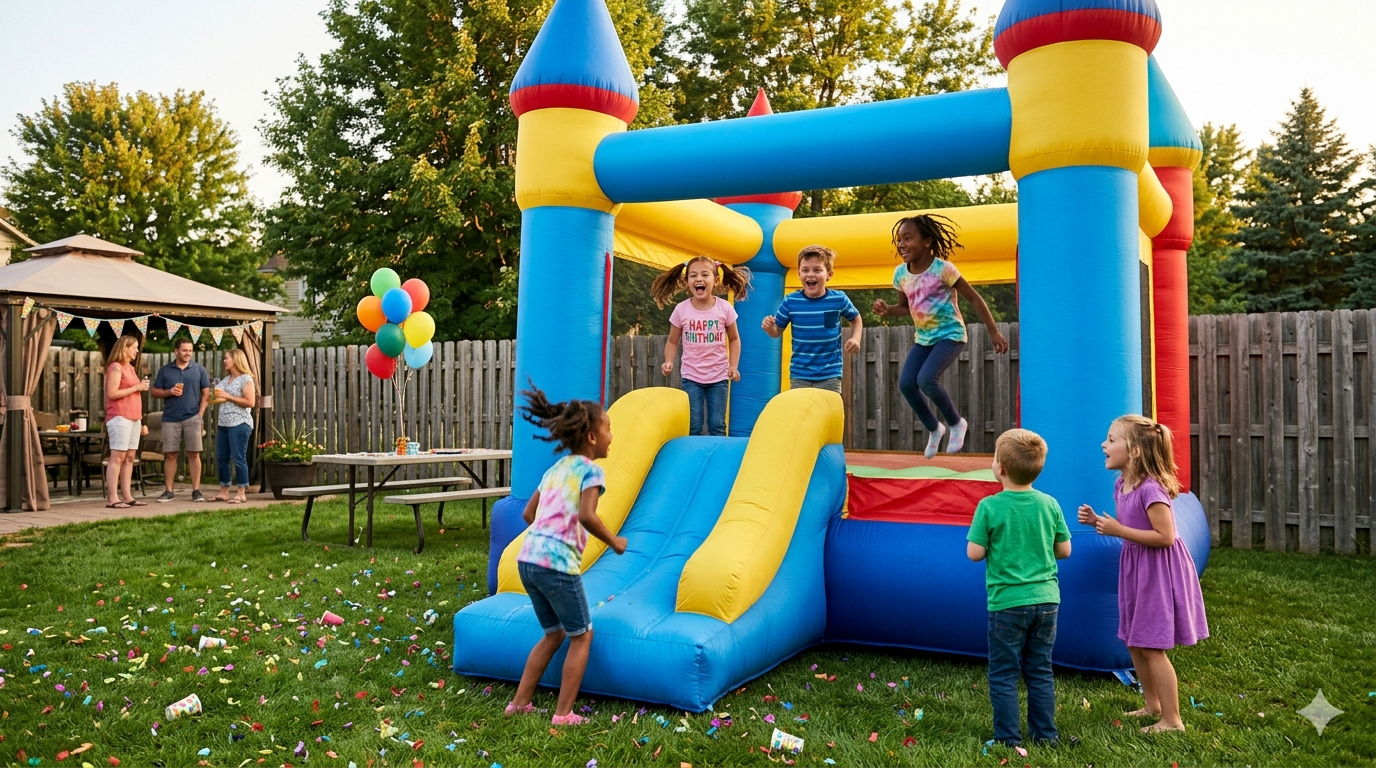
A bounce house birthday party is one of those ideas that sounds simple right up until you're three weeks out and realize you haven't booked anything, your backyard has a slope you forgot about, and your child has invited fourteen kids to a unit rated for six.
I've been there. Most parents have.
The good news is that with a little advance planning, a bounce house party is genuinely one of the easiest formats to pull off well. Kids essentially entertain themselves for two hours, parents can actually have a conversation, and the birthday kid feels like royalty. There's a reason these parties have become so popular.
Here's everything I'd want to know before planning one — from booking timing to day-of logistics to what to do when it rains.
Step 1: Book the Bounce House Before You Send Invitations
This is the single most important piece of advice in this entire guide. Book the bounce house first, then send the invitations.
I can't tell you how many parents do this backwards — they send out invitations, get a headcount, and then try to book a unit, only to find that their preferred company is sold out for that Saturday. Summer weekends book out four to six weeks in advance at reputable companies, and popular or themed units go even faster. During peak season (late May through August), six to eight weeks out is not overcautious — it's just realistic.
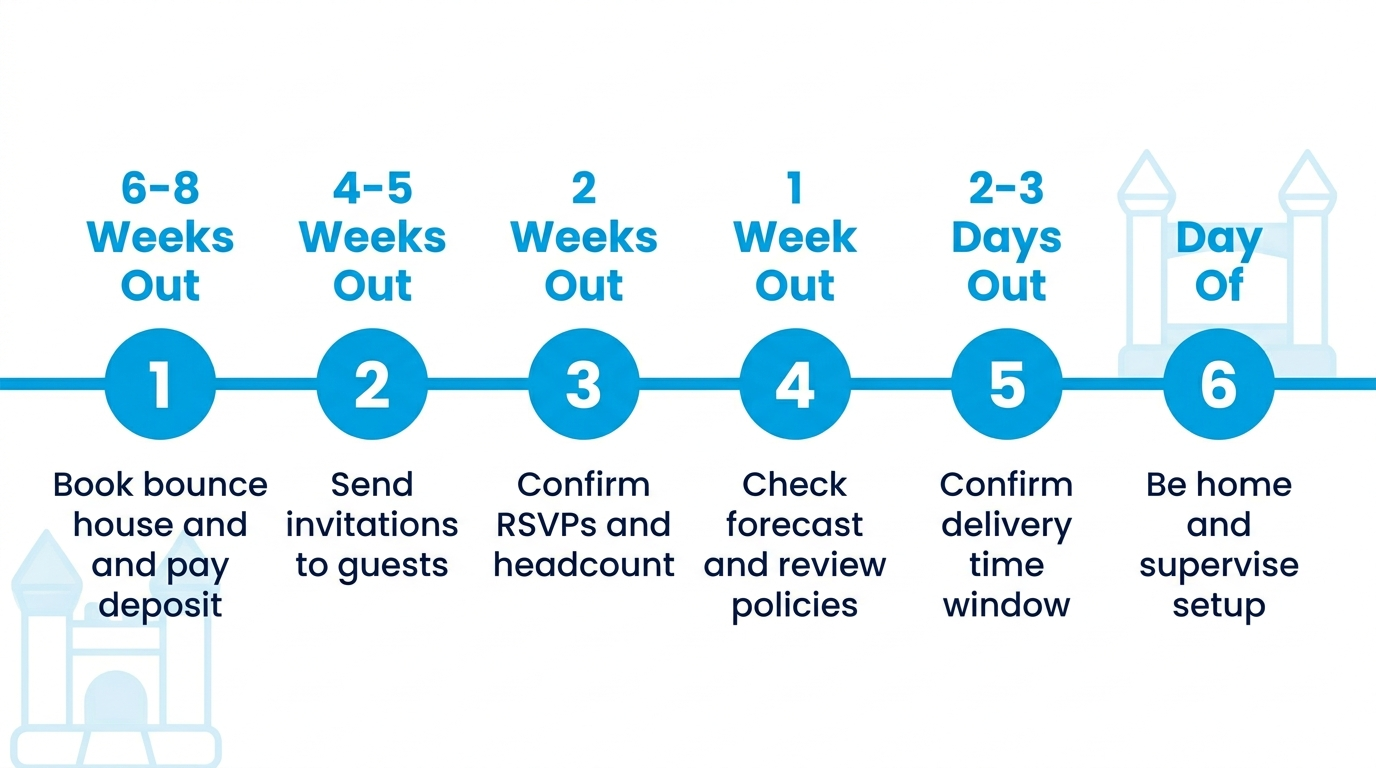
Here's a simple timeline that works for most parties:
| When | What to Do |
|---|---|
| 6–8 weeks out | Choose your date, pick your rental company, book and pay the deposit. Confirm size and unit type. |
| 4–5 weeks out | Send invitations. Now that the bounce house is locked in, you can confirm the date with confidence. |
| 2 weeks out | Follow up on RSVPs. Confirm headcount. Check in with the rental company to verify your booking. |
| 1 week out | Check the weather forecast. Review the company's cancellation/weather policy. Prep the yard. |
| 2–3 days out | Confirm delivery time window with the rental company. Clear the setup path in your yard. |
| Day of | Be home for delivery. Do a quick safety walkthrough before guests arrive. Have the rental company's number handy. |
For fall and winter birthdays, or weekday parties, you have more flexibility — two to three weeks out is usually fine. But if your child's birthday falls between Memorial Day and Labor Day on a weekend, treat the six-week lead time as a hard rule.
Step 2: Choose the Right Size Unit for Your Guest Count
Sizing is where a lot of first-time renters make mistakes — usually by either going too small (miserable overcrowding) or defaulting to the biggest unit available without checking whether it actually fits the yard.
Here's a practical sizing guide based on guest count and age:
| Bounce House Size | Safe Capacity | Best For |
|---|---|---|
| Small (11x11 or 13x13) | 4–6 kids at once | Toddlers and younger kids (under 6), small guest counts, tight yards |
| Medium (15x15) | 6–8 kids at once | The "default" party size — works well for most backyard birthdays with mixed ages |
| Large / Combo Unit | 8–12 kids at once | Bigger parties, older kids (7+), families who want a slide or extra features |
| Obstacle Course | Rotational — one at a time | Larger groups, competitive kids, school-age parties |
A few things worth keeping in mind: capacity refers to how many kids can bounce safely at the same time, not total guest count. At a party of fifteen kids, they'll naturally rotate in and out — you don't need a unit that fits all fifteen at once. A medium 15x15 unit handles most backyard birthday parties comfortably.
Also: bigger units need more yard space, and not just the footprint of the inflatable itself. You need at least three feet of clear space on all sides for safety, plus clear access for the delivery crew and their equipment. Measure your usable yard space before you book — not just the total lawn, but the usable flat area once you account for trees, garden beds, fencing, and slope.
Step 3: Think Through the Logistics Before the Day
The parties that go smoothly are the ones where the parent thought through the logistics in advance and handled a few small things that are easy to forget.
Power access. A bounce house blower needs a standard 110V outlet — and it needs to stay plugged in the entire time the unit is inflated. The outlet needs to be within 50-150 feet of the setup location (rental companies typically bring heavy-duty extension cords). If your setup spot doesn't have easy power access, ask the rental company about generator options before the day arrives, not when the truck is in your driveway.
Clear the setup path. The delivery crew needs a clear path from the street or driveway to your setup location. This means gates unlatched and wide open, garden hoses moved, kids' bikes cleared, nothing blocking the route. A commercial bounce house on a dolly is heavy and awkward — a cluttered path creates real hassle and sometimes damages things in the way. My own wheelbarrow did not survive first contact with a rental unit.
Flat surface. Bounce houses need to be set up on relatively flat ground. A gentle slope is usually manageable; a significant grade is not. If your yard has any meaningful slope, flag this when booking and ask the rental company whether it will work for the specific unit.
Timing your rental window. Think about when the party actually starts and when kids will actually be bouncing, not just the party start time. If guests arrive at 2pm and the party ends at 5pm, you want the bounce house fully set up and ready by 1:45pm at the latest. Delivery crews typically arrive 30-60 minutes before your requested start time — confirm this with your company and build the buffer in.
Shoe policy. No shoes inside the bounce house — this is both a safety rule (laces can catch) and a cleanliness one. Have a spot near the entrance for shoes and make sure parents know about it. A small sign works well.
Two things worth having on hand before the delivery truck arrives — whether you're renting or own your own unit. A heavy-duty 100-foot outdoor extension cord handles most power access situations without having to reroute the setup location. And if you own your unit and are doing self-setup, proper vinyl sandbags are the right anchoring solution on any hard surface where stakes won't work.
/primary/Amazon Basics 100 Foot 3-Prong Vinyl IndoorOutdoor Extension C (B00OS7ELK6)_large.jpg)
/primary/Vinyl Sand Bag, 6 Pack, SupportAnchor for Inflatables, Bounce (B06XF8KQ1Y)_large.jpg)
Step 4: Plan for Supervision
A bounce house is not a babysitter. This is the part of the guide that sounds obvious but is genuinely important.
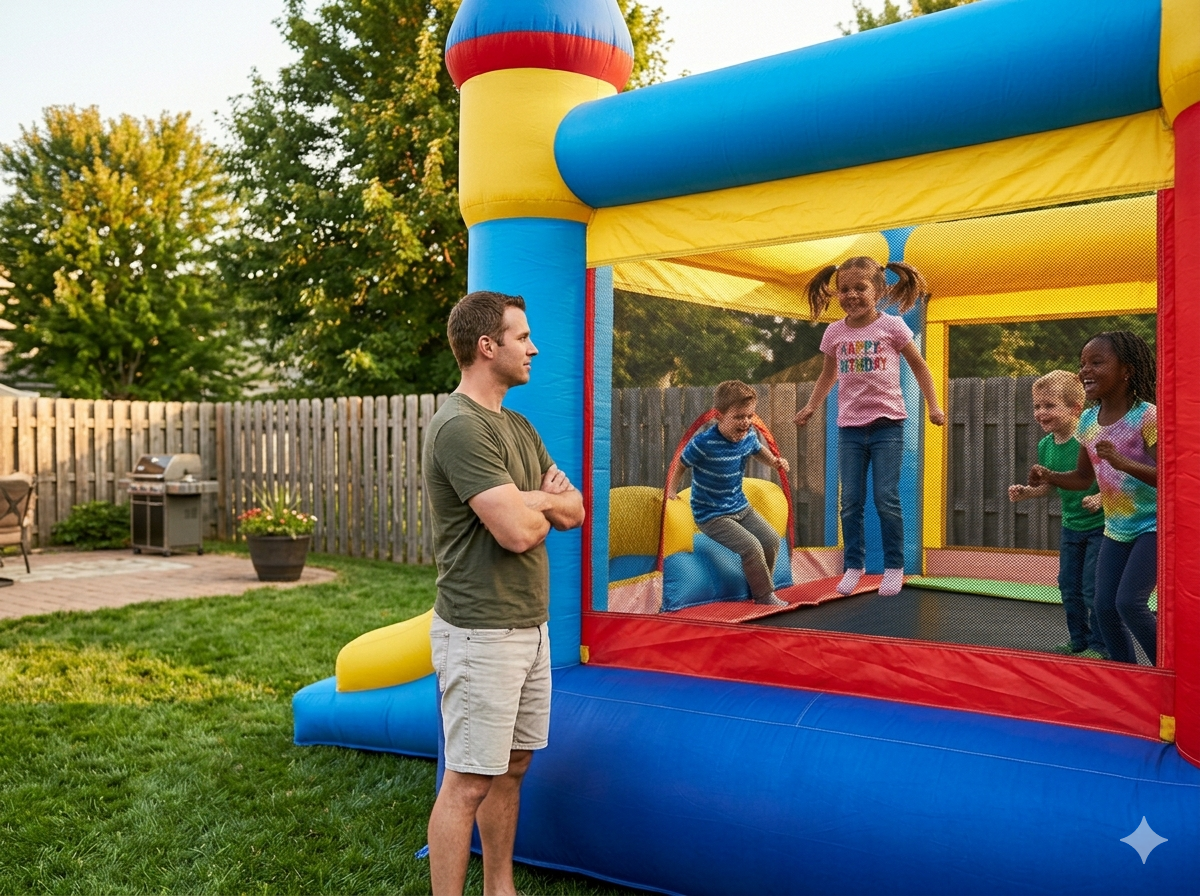
Most bounce house injuries happen from too many kids inside at once, kids of very different sizes bouncing together, or someone attempting something acrobatic. None of these are hard to prevent — they just require an adult paying attention rather than chatting with the other parents across the yard.
Designate one adult as the bounce house supervisor for the duration of the party. Rotate this role with another parent if needed so nobody is stuck doing it the whole time. The supervisor's job is simple: enforce capacity limits, keep big kids and little kids separated, and make sure nobody is trying to do backflips.
If you have a wide age range of guests — say, a mix of five-year-olds and ten-year-olds — consider doing age-separated bounce sessions rather than open bouncing. Fifteen minutes for the little kids, fifteen for the big kids. It's better for safety and, honestly, more fun for everyone since the little ones aren't getting steamrolled.
Step 5: Have a Weather Backup Plan
Weather is the one thing that can genuinely derail a well-planned bounce house party, and it deserves more than a shrug and a "hopefully it'll be fine."
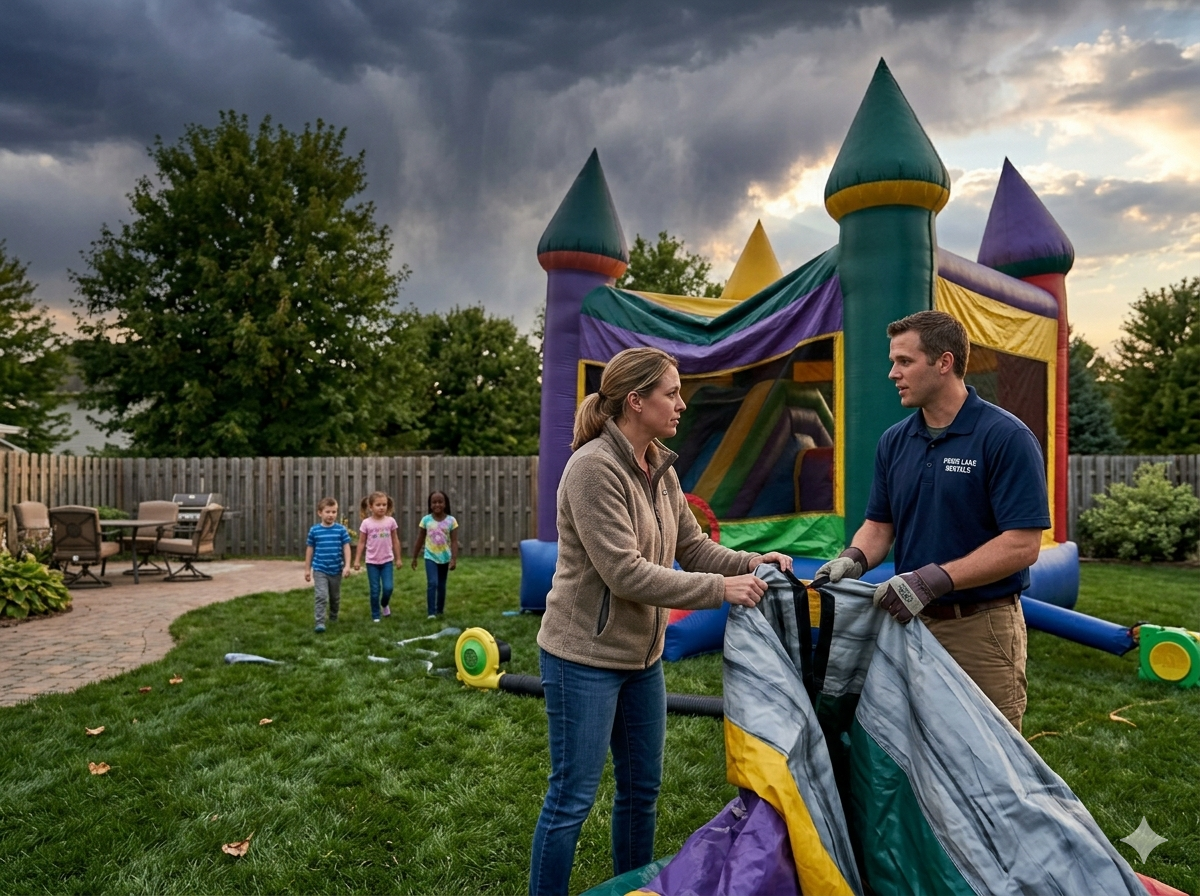
Start watching the forecast about a week out. Know your rental company's weather policy — specifically, what wind speeds or rain conditions trigger their right to cancel, and what happens to your payment if they do. Some companies issue a raincheck valid for a year; others keep the deposit. You need to know this before the day of the party, not when you're calling them at 8am in a panic.
A light drizzle is usually fine — kids will bounce in it and have a blast. The real concern is wind. Most manufacturers recommend removing children from bounce houses when winds exceed 15 mph. If the forecast shows sustained wind, the unit needs to come down regardless of how disappointed anyone is. Tears dry faster than broken bones heal.
For your backup plan: think about what you'd do if the bounce house isn't available. A few simple outdoor games (relay races, a water balloon toss if it's warm, a scavenger hunt) can rescue a party that loses its centerpiece. Having a plan — even a loose one — means you stay calm if things go sideways rather than melting down in front of twenty kids and their parents.
Helpful Resource
Before your rental arrives, run through our complete bounce house rental checklist. It covers the day-of preparation items that are easy to forget in the party planning chaos.Should You Rent or Buy for a Birthday Party?
If you're only doing this once a year, renting is almost certainly the right call. A commercial rental unit is larger, more impressive, and more feature-rich than anything in the consumer price range — and you don't have to store it, maintain it, or inflate it yourself.
That said, if you find yourself throwing a bounce house party every year and using it a few extra times in the summer besides, the math starts to shift. A quality residential unit in the $500-$700 range can pay for itself within two seasons of regular use.
For families considering a purchase, Blast Zone is the brand I'd start with — their two-year warranty and construction quality are genuinely better than the competition at similar price points. The Blast Zone Triple Play in particular is sized and featured well enough to serve as both a party unit and an everyday backyard toy. For younger kids specifically, Little Tikes makes well-sized units that are affordable enough to justify buying even for occasional use.
For the full breakdown on how to think through that decision, see our renting vs. buying guide.
Budget Snapshot: What a Bounce House Birthday Party Actually Costs
For parents doing this for the first time, here's a realistic all-in budget for a backyard bounce house birthday party for 15-20 kids:
| Item | Typical Cost |
|---|---|
| Bounce house rental (medium unit, full day) | $200 – $350 |
| Delivery fee | $0 – $75 |
| Cake | $30 – $150 |
| Food and drinks | $75 – $200 |
| Decorations | $20 – $60 |
| Goodie bags ($3-5 per kid) | $45 – $100 |
| Total | $370 – $935 |
The wide range reflects choices you control — a grocery store cake vs. a custom bakery cake, simple decorations vs. an elaborate theme, pizza and juice boxes vs. a catered spread. Most families land somewhere in the $400-$600 range for a solid, well-executed backyard bounce house party. That's a genuinely good value for two hours of kids entertaining themselves while adults actually enjoy the party.
Worth noting: if you're considering buying instead of renting, the Blast Zone Pirate Bay is one of the best premium combo units available at the residential level — a 20x12 water park with slide, climbing wall, tunnel, and splash pool. At that price point it pays for itself in two or three summers of party use compared to rental costs.
/primary/Blast Zone Pirate Bay - 20x12 Huge WetDry Bounce House Water P (B001QT0FUY)_large.jpg)
Blast Zone Pirate Bay Inflatable Water Park with Blower
- HUGE FUN ✔️ At 20’L X 12’W X 8'H the Pirate Bay Includes a Huge Splash Area.
- TONS OF FEATURES ✔️ Slide! Bouncer! Tunnel! Climber! Cannons! Huge Splash Area!
- SAFETY FIRST✔️ Fully-Enclosed with Safety Netting.
- UNMATCHED DURABILITY✔️ With Blast Zone's High Standards & Puncture-Resistant Material.
- INFLATES IN SECONDS✔️ Includes Blower, Storage Straps, Stakes and 2-Year Promise.
The Bottom Line
A bounce house birthday party doesn't require a lot of effort to pull off well — it just requires a little planning upfront and the right sequence of decisions. Book early, size the unit for your actual yard and guest count, think through the logistics before the day, and have a weather plan. Do those four things and you've got a party your kid will talk about for years.
The rest is just cake and chaos. Which, honestly, is what birthday parties are supposed to be.