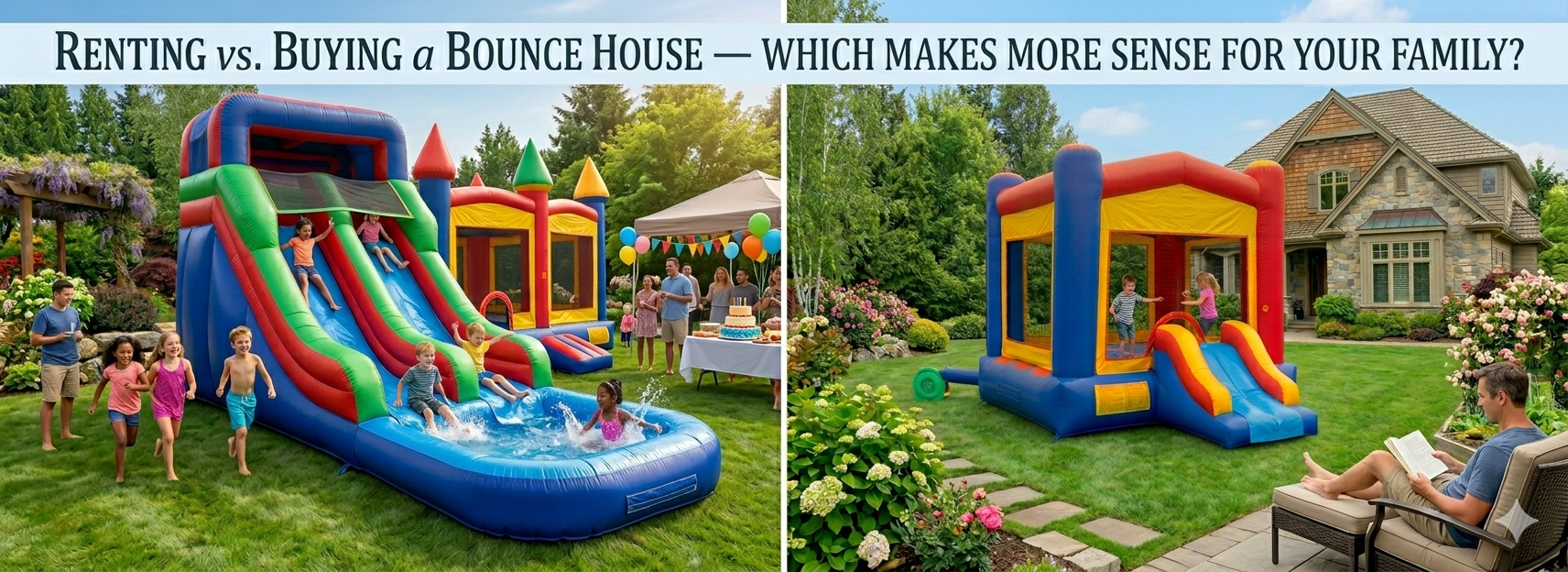
Every summer, some version of this question comes up in parent groups, neighborhood chats, and backyard conversations: should we just buy one of those things?
It's a fair question. If you're paying $200-$300 every time you rent a bounce house for a birthday party, it doesn't take long before buying starts to feel like the smarter move. But it's also not quite that simple — and I've seen plenty of parents go both directions and regret it.
The short answer: If you'll use it three or more times a year, buying probably makes financial sense. If you'll use it once or twice, renting almost certainly wins. But the financial comparison is only part of the story — and for some families, the non-financial factors are actually more decisive.
Let me walk you through both sides of this honestly.
The Real Cost of Renting
A standard bounce house rental typically runs between $150 and $300 for a four-to-eight hour window, depending on your market and the type of unit. Add a delivery fee — usually $25 to $75 depending on distance — and you're looking at $200-$375 for a single-day rental of a basic unit.
Water slides and combo units (bounce house plus slide) run higher, often $300-$500 or more for a day. Obstacle courses can push past $600 in some markets.
That said, you're getting something real for that money. A rental company delivers a commercial-grade unit — far more durable and spacious than anything in the consumer price range — sets it up, picks it up, and handles everything in between. For a once-a-year birthday party, that's a genuinely good deal.
The Real Cost of Buying
A decent consumer-grade bounce house starts around $200-$300 for a small unit appropriate for younger kids. A mid-range model with a slide runs $400-$700. The better residential units — the ones that will actually hold up to a few years of use — tend to run $500-$800.
Here's the thing most people miss though: the purchase price isn't the total cost. You'll also need to factor in:
- Storage. A deflated bounce house takes up real space — think a large duffel bag the size of a small refrigerator. You need a dry, temperature-controlled space or it will mold.
- Maintenance. Consumer units need to be cleaned, dried completely before storage, and occasionally patched. This isn't hard, but it takes time and attention.
- Setup and takedown. Plan on 20-30 minutes to inflate and another 20-30 to deflate, dry, and pack up. You'll be doing this yourself.
- Replacement. A consumer bounce house used heavily won't last forever. Budget for eventual replacement.
The Break-Even Math
Let's use round numbers. Say rentals in your area average $250 all-in, and a good consumer bounce house costs $600.
At one rental per year, it takes you 2.4 years just to break even on the purchase price — before accounting for storage hassle, maintenance time, and the fact that a rental unit is a much larger, more impressive commercial-grade inflatable.
At two rentals per year (two birthday parties, or a party plus a summer gathering), break-even is 1.2 years. After that, every use is essentially free.
At three or more uses per year, buying is a clear financial winner. Your cost-per-use drops quickly, and you get the added bonus of being able to set it up on a random Tuesday afternoon just because it's hot outside.
Quick Tip
If you find yourself renting more than twice a year, take a look at some of our top-rated residential bounce houses. A good unit in the $500-700 range can pay for itself within a season.What You Give Up By Renting
Beyond the cost, there are a few real frustrations that come with renting that don't show up in the price comparison.
Availability. Popular units book out weeks in advance for summer weekends. If you have a spontaneous cookout or a last-minute party, a rental company may not be able to help you. I've personally had to scramble to find a replacement when a company cancelled last-minute — not fun when a six-year-old is expecting a bounce house at their party.
Cleanliness. Reputable companies clean and sanitize between rentals, but you're trusting their process. When you own one, you control exactly how it's cleaned.
Selection. The unit you want may not be available on the day you need it. With your own, you always have exactly the unit your kids love.
What You Give Up By Buying
Ownership has its own frustrations, and they're worth being honest about.
Size. Consumer-grade units are noticeably smaller than rental units. A $600 bounce house is not the same experience as a $2,000 commercial rental. If your kids have been to parties with rental units and you show up with a consumer model, they'll notice.
Setup effort. Setting up a bounce house solo is manageable. Taking it down, getting the air out, getting it completely dry, and packing it back into the bag is a project. On a hot summer afternoon after a party, it's a sweaty, tedious project.
Warranty limitations. Most consumer bounce houses come with a 90-day warranty on the inflatable itself. After that, any repairs are on you. The better brands offer more — Blast Zone, for instance, offers a two-year warranty on their residential units, which is genuinely exceptional for this category.
Storage space. If you don't have a garage or dry storage area, buying a bounce house is a mistake. Storing one in a damp basement or outdoor shed is a recipe for mold.
A Simple Decision Framework
Here's how I'd think through this decision:
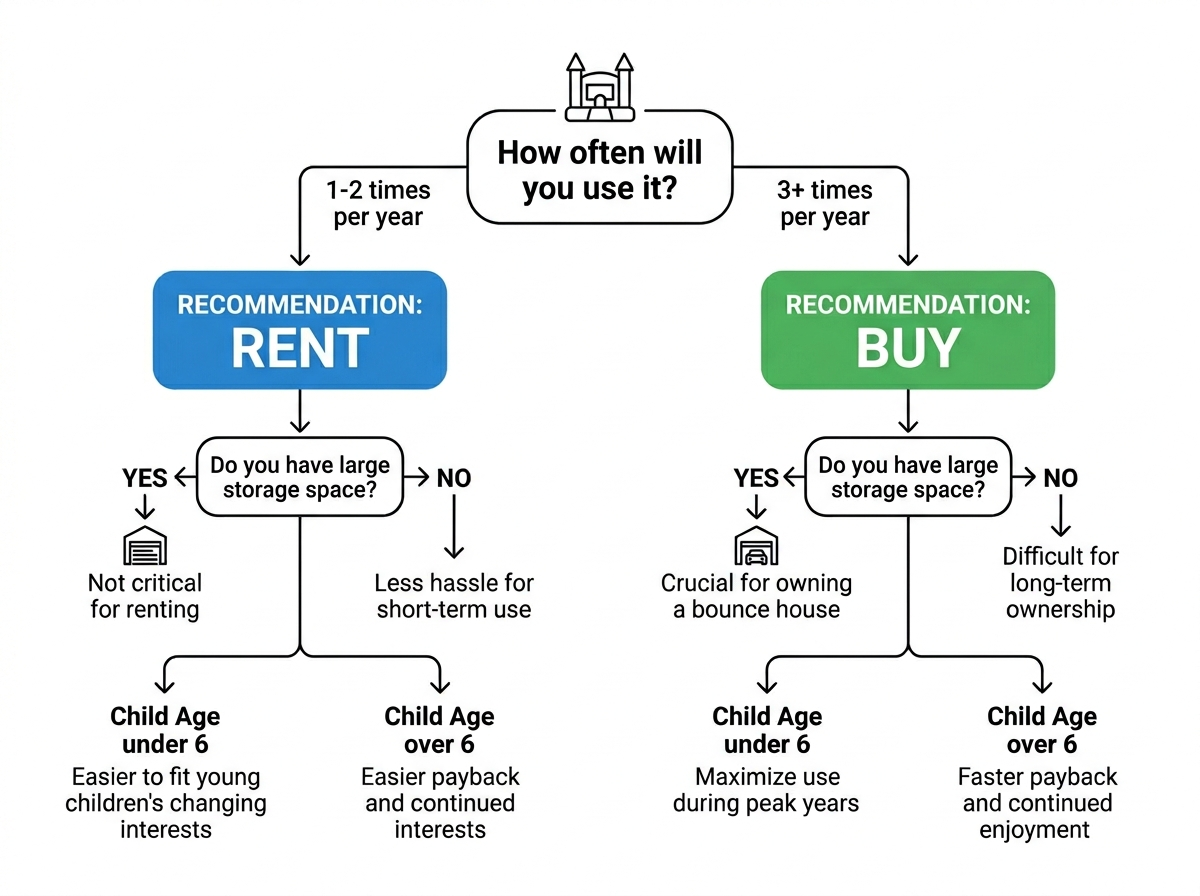
And here's a slightly different way to visualize the decision framework:
| Your Situation | Recommendation |
|---|---|
| One party per year, maybe two | Rent. The math favors it and the hassle of ownership isn't worth it. |
| Three or more uses per year | Buy. You'll break even quickly and get way more value out of ownership. |
| Kids under 5-6 years old | Consider buying a smaller unit from Little Tikes. They're sized right for little ones and affordable enough that the bar for break-even is low. |
| Older or rowdier kids (7+) | Lean toward renting a commercial unit. Consumer units take a beating from bigger kids. |
| No garage or dry storage | Rent. Full stop. A moldy bounce house is worse than no bounce house. |
| Small yard or limited space | Check dimensions carefully before buying. Many consumer units are actually quite compact — but measure first. |
| Want the biggest, most impressive setup | Rent. Commercial rental units are a different class of product. |
If You Decide to Buy
If the math works out in favor of buying, the brand you choose matters more than most people realize. The bounce house market is flooded with off-brand units that look fine in product photos and fall apart after a season.
My top recommendation for most families is Blast Zone. Their two-year warranty is unmatched in the residential category, their construction quality is genuinely better than the competition, and they hold their value well enough that you can resell when your kids outgrow it.
For families with younger kids (roughly 6 and under), Little Tikes makes excellent smaller units that are sized appropriately and affordable enough to justify buying even with lighter use. Their Dunk N Toss Bouncer and Jump 'n Slide are both solid options.
For a full breakdown of which brands are worth your money, see my guide to the best bounce house brands.
If You Decide to Rent
Renting is absolutely the right call for a lot of families, and there's no shame in it. The experience you get from a commercial rental unit — the size, the wow factor, the fact that someone else does all the heavy lifting — is genuinely hard to replicate with a consumer purchase.
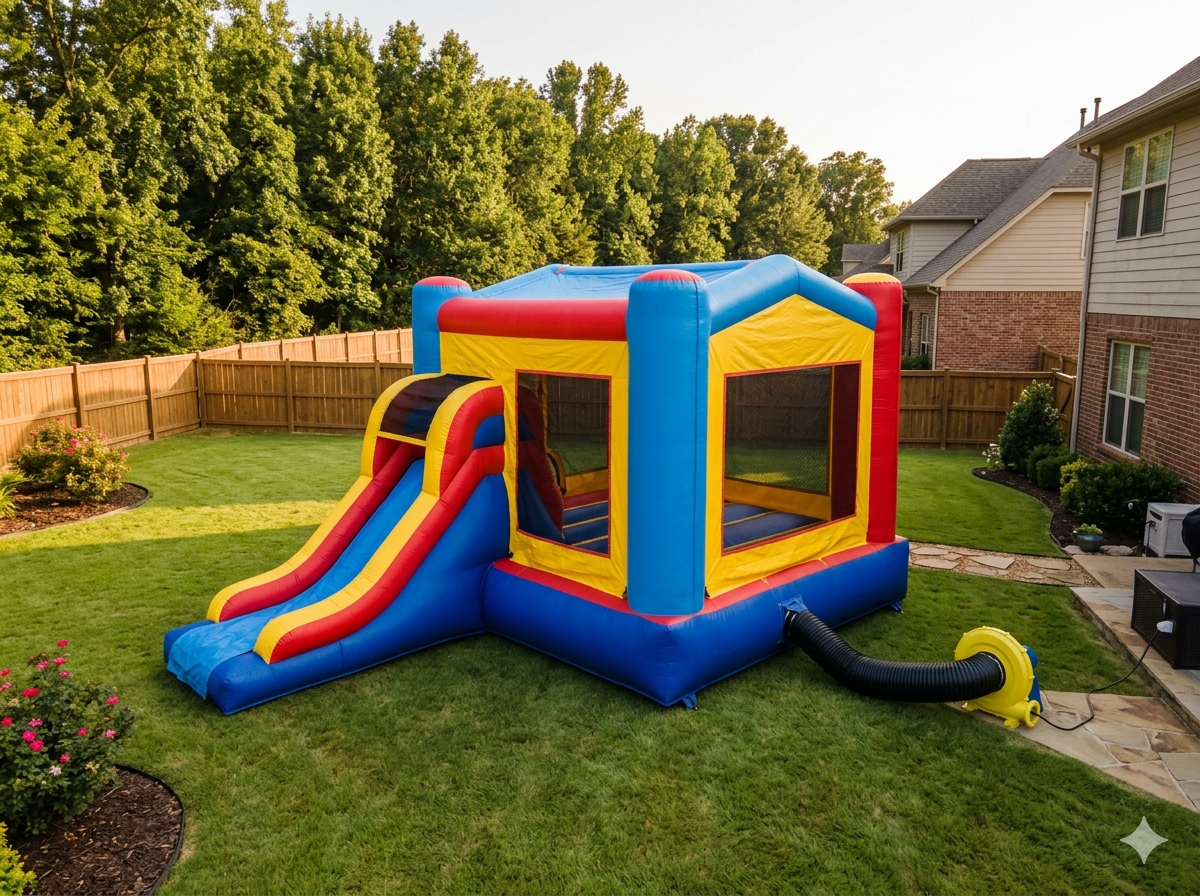
A few things that will make your rental experience much smoother:
Book early. For summer weekends and popular party dates, the best units book out four to six weeks in advance. If you're planning a birthday party, get the bounce house locked in before you send invitations.
Understand the delivery terms up front. Ask whether delivery is included in the quoted price, what the cancellation policy is on both ends, and whether there are any setup requirements you need to prepare for (flat surface, clear path to the setup area, access to power).
For a full checklist of what to think through before your rental arrives, check out my bounce house rental checklist. It'll save you some headaches on the day of the party.
The Bottom Line
There's no universally right answer here — it genuinely depends on your situation. But the framework is simple: run the break-even math for your rental frequency, be honest about your storage situation, and think about the age and energy level of the kids who'll be using it.
For most families, renting makes sense until you're using it three or more times a year. At that point, a quality unit from a trusted brand starts to look like a very reasonable investment.
Either way, your kids are going to have a great time. That part is pretty much guaranteed.