Let me start with a number that tends to get people's attention: bounce houses send an estimated 10,000 children to the emergency room every year in the United States. Fractures, sprains, and head injuries make up the vast majority of those visits — and more than one in four injuries is a broken bone.
I'm not telling you this to scare you off bounce houses. I'm telling you because most of those injuries are preventable, and the parents in the room when they happen usually didn't know what to watch for. A well-run rental from a reputable company, with an attentive adult supervising, is genuinely safe. The injuries happen when the setup is wrong, the supervision is absent, or the weather turns and nobody acts on it.
Here's what the research says about the risks, what good rental companies do about them, and what parents need to do on their end.
The Two Categories of Risk
Bounce house injuries generally fall into two distinct categories, and they have very different causes and solutions.
The everyday risk: collisions and falls inside the unit. This is where the bulk of that 10,000-per-year ER visit number comes from. Kids bouncing into each other, bigger kids landing on smaller kids, someone attempting a flip and landing badly, children falling out of the entrance. These injuries are almost entirely a supervision and capacity problem — they happen when too many kids are inside at once, when the age and size mix is too wide, or when no adult is paying attention.
The serious risk: wind. A University of Georgia study documented 132 wind-related bounce house incidents worldwide between 2000 and 2021, resulting in at least 479 injuries and 28 deaths. In 2024 alone, a 5-year-old boy died in Maryland when wind gusts lifted a bounce house 15 to 20 feet into the air at a baseball game, and a 2-year-old was killed in Arizona in a similar incident months earlier. These are not freak events — they are the predictable outcome of an inflatable left up in conditions that exceed safe wind thresholds. Alarmingly, over a third of wind-related incidents have occurred in winds of just 0–20 mph, conditions most people would consider harmless.
The good news is that both categories of risk are highly manageable. The practices below address both directly.
What to Look for in a Rental Company's Safety Practices
Your first layer of protection is choosing a rental company that takes safety seriously. Before the unit ever arrives at your home, there are things worth verifying.
Insurance — the non-negotiable. Every legitimate bounce house rental company carries general liability insurance. The minimum industry standard is $1 million per occurrence. In Texas, state law requires operators to carry at least $1 million in combined single-limit bodily injury and property damage coverage and to file certification with the state annually. Florida, California, and several other states have similar regulatory frameworks. Ask for a certificate of insurance before booking. A company that hesitates or deflects on this question is not worth your business.
Annual safety inspections. In states like Texas, annual safety inspections are legally required for certified operators — and each unit should carry a certification sticker showing it has passed. Ask whether the specific unit you're renting has been inspected and when. A reputable company will have this documentation ready. Units certified to ASTM F2374 (the industry standard for inflatable amusement devices) have been built and tested to a defined safety specification.
Professional setup and anchoring. An improperly anchored unit is the setup condition that makes wind incidents possible. A reputable rental company stakes the unit on grass or uses sandbags on hard surfaces, positions the blower safely, and doesn't leave until the anchoring is verified. Drop-off-only rentals — where the company delivers the deflated unit and leaves setup to you — skip this critical step. If you're considering a drop-off rental to save money, understand that proper anchoring is the tradeoff you're making.
A safety walkthrough before they leave. Before the crew departs, they should walk you through capacity limits for the specific unit, the weather threshold for deflating, and basic rules for safe use. This isn't optional — it's standard practice for companies that operate professionally. If a crew sets up a unit and leaves without a word, ask them to come back and walk you through it.
For a full guide on vetting rental companies before you book, see our bounce house rental company guide — it covers insurance verification, cleaning practices, and red flags in detail.
Supervision — The Parent's Job
The rental company gets the unit to your yard safely. What happens inside it is your responsibility. This is where most injuries actually occur, and where attentive adult supervision makes the biggest difference.
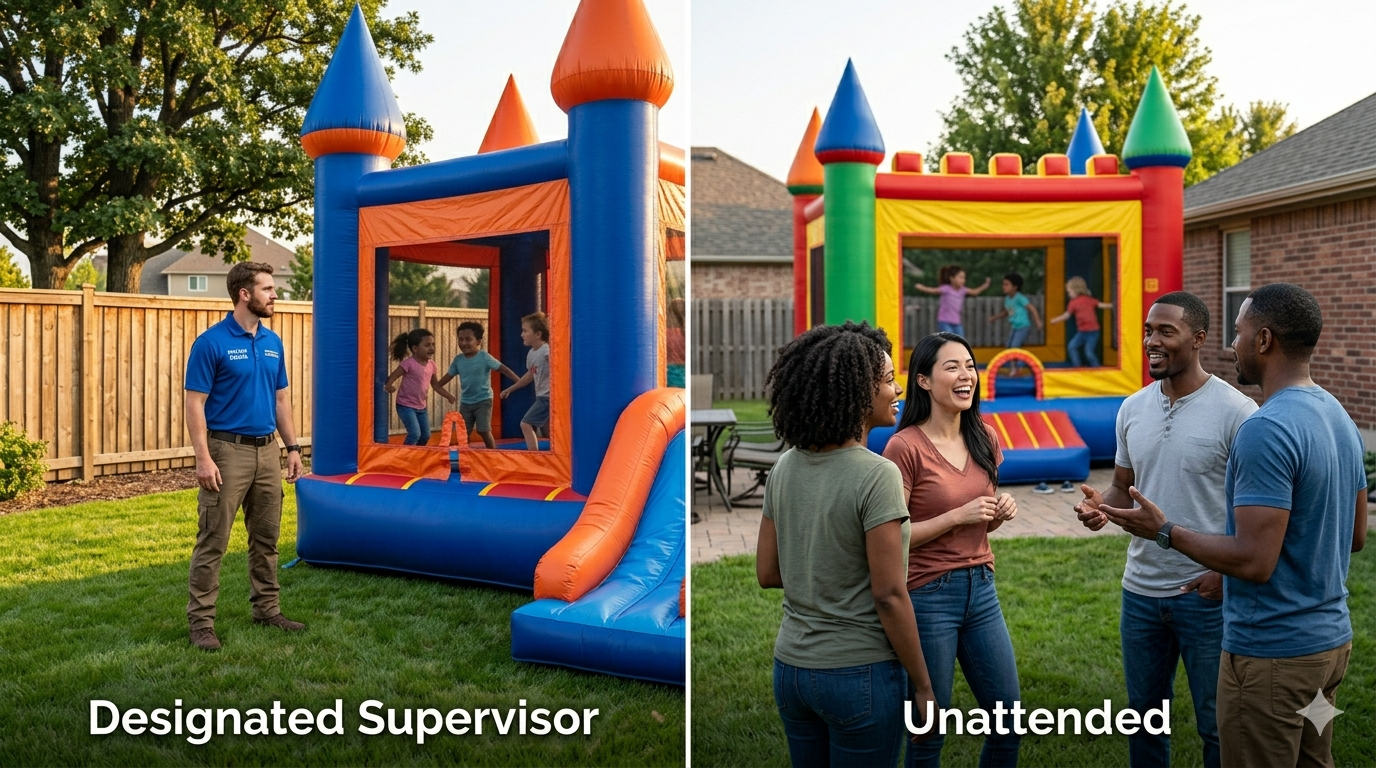
Designate one adult as the supervisor. Not "sort of keeping an eye on it" from across the yard — one adult whose specific job for the duration of the party is watching the bounce house. Rotate this with another parent if the party is long. The supervisor's role is to enforce capacity, separate incompatible age groups, and stop dangerous behavior before it results in an injury.
Enforce capacity limits strictly. Every unit has a weight and capacity limit. Exceeding it increases the risk of collision injuries and puts stress on the unit's structure. If the rental company says six kids at a time, six kids at a time means six — not eight because a couple of them are small.
Separate big kids and little kids. This is the single most effective thing a supervisor can do. The injury risk spikes dramatically when a wide age range bounces together — a 10-year-old and a 4-year-old in the same bounce house at the same time is a recipe for someone getting hurt. Run age-separated sessions if your guest list spans more than three or four years in age range. It's better for safety and, frankly, more fun for both groups.
No shoes, no sharp objects, no food or drinks inside. Shoelaces catch. Jewelry and belt buckles create contact hazards. Food and drinks make surfaces slippery. These rules exist for real reasons — enforce them consistently.
One at a time on any slide. If the unit includes a slide, one rider at a time per lane is the rule, and nobody goes until the previous rider has cleared the bottom and moved away. Collisions at the base of slides are a common injury mechanism.
No flips, no roughhousing. Most bounce house injuries that involve broken bones are the result of failed aerial attempts. Make this a clear rule at the start and enforce it. Kids will push back; enforce it anyway.
Weather — The Risk Most Parents Underestimate
Wind is the most dangerous thing that can happen at a bounce house event, and it's the one risk where parents consistently underestimate the threshold. Over a third of wind-related bounce house incidents have occurred in conditions of 0–20 mph — winds that feel like a light to moderate breeze. A bounce house is essentially a giant balloon, and it behaves accordingly in wind.
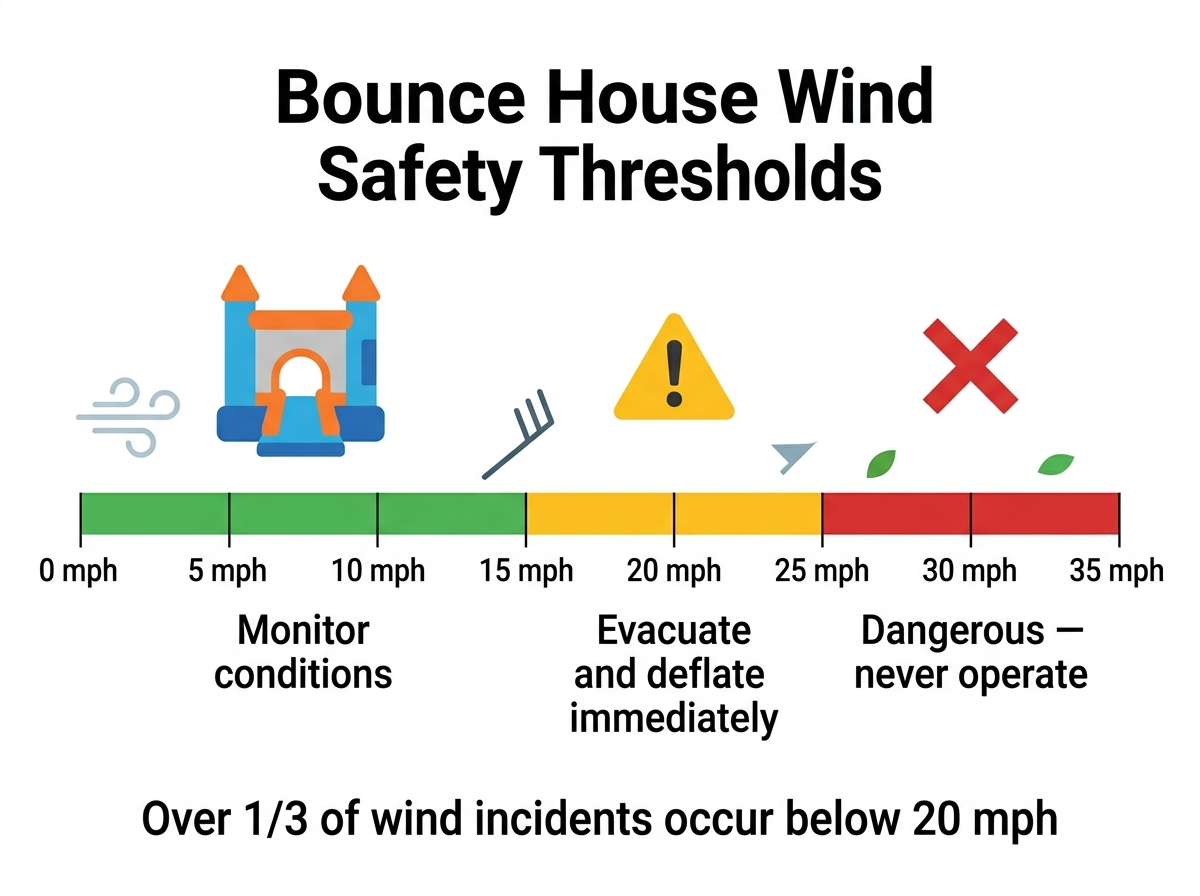
The standard threshold recommended by most manufacturers and safety organizations is 15–25 mph sustained wind. Some manufacturers set their limit as low as 15 mph. When wind reaches that level, children come out and the unit gets deflated — not anchored down harder, not monitored more closely, deflated. There is no safe way to keep children in an inflatable when wind conditions exceed the manufacturer's threshold.
Practical steps for managing weather on your rental day:
- Check the forecast starting a week out. Know what's coming. If wind is in the forecast, have a plan.
- Know the specific wind threshold for your rental unit. Ask the rental company when you book: "At what wind speed should we deflate the unit?" Get a specific number, not a vague answer.
- Have a weather app with wind speed data on your phone. Sustained wind speed and gusts are different — gusts are what lift inflatables. Monitor both.
- Act on wind before it becomes a problem. If conditions are approaching the threshold, clear the unit and deflate it. Don't wait to see if it gets worse. The Maryland incident happened quickly — the bounce house was up one moment and 15 feet in the air the next.
- Deflate during lightning within 10 miles. This is standard safety practice regardless of wind conditions.
Heat — The Risk Nobody Talks About
A University of Georgia study found that the interior of bounce houses can reach a heat index of 104–117°F on a warm day — significantly higher than the ambient temperature outside. For children playing actively inside, this creates real dehydration and heat exhaustion risk, particularly during summer afternoon parties.
A few practical steps that make a meaningful difference: Schedule outdoor bounce house time for morning or early evening rather than peak afternoon heat. Keep cold water easily accessible right outside the unit and enforce regular water breaks. Set up a shade area nearby where kids can cool down between bouncing sessions. If the unit is in direct sun all afternoon, be more aggressive about rotation and rest time.
State Regulations Worth Knowing
Regulatory requirements for bounce house rental operators vary significantly by state. Some states have robust frameworks with mandatory inspections and insurance filing requirements; others have minimal oversight. Here's a brief overview of the states that make up the largest portion of our readership:
| State | Key Requirements |
|---|---|
| Texas | Operators must register with the Texas Department of Licensing and Regulation. Minimum $1M liability insurance required. Annual safety inspections mandatory; certification sticker issued per unit. Filed with state annually before July 1. |
| Florida | Inflatables classified as amusement rides and regulated by the state. Operators required to carry liability insurance and submit to annual inspections. Local county requirements may be stricter. |
| California | Regulated under the California Department of Industrial Relations. Annual inspection required. Insurance requirements vary by jurisdiction; some cities have additional permitting requirements for public events. |
| New York | Regulated by the New York State Department of Labor. Annual inspection and insurance required. NYC has additional permitting requirements for inflatables in public spaces. |
| Illinois | Regulated under the Illinois Amusement Ride and Attraction Safety Act. Annual inspection required; operators must obtain a permit. Insurance requirements apply. |
| Ohio / Virginia | Both states require registration and insurance for commercial operators. Annual inspections generally required. Specific requirements vary — check with the rental company about local compliance. |
Regardless of your state's regulatory framework, the practical question is the same: ask the rental company whether they are licensed, insured, and whether their units have passed recent inspections. A company operating in compliance with their state's requirements will be able to answer all three without hesitation.
A Quick Pre-Party Safety Checklist
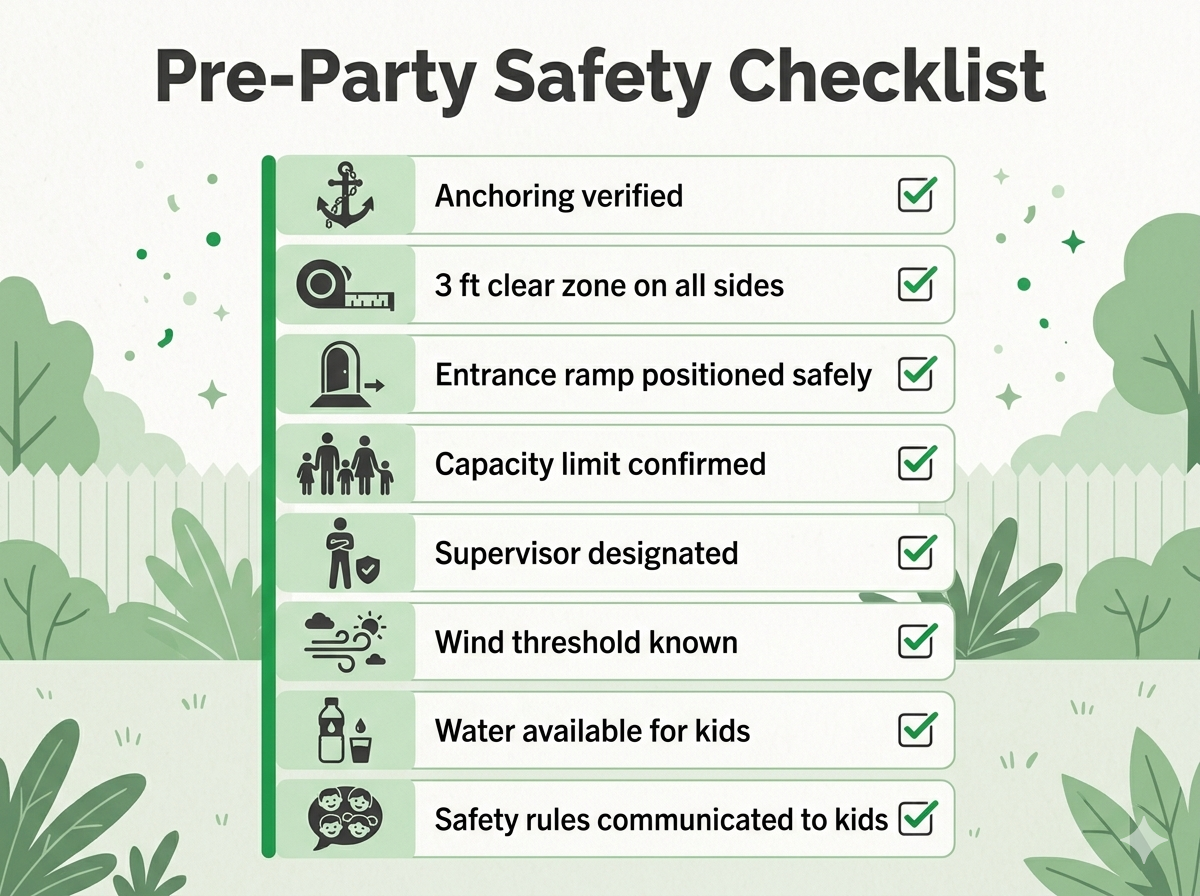
Before the first kid steps inside on party day, run through this list:
If you don't follow through with these items you're not only taking on additional liability but you're also putting your child's health and safety at risk, along with that of all their friends. Nobody wants the party to end early because somebody got hurt. Worse yet, nobody wants to deal with angry parents who show up at the end of a party to find a chaotic scene.
Here's a more detailed breakdown of the safety checklist that will help ensure your party is a success and that your child and all of their friends have a great time:
| Check | What to Verify |
|---|---|
| Anchoring | Unit is staked firmly or weighted with sandbags. Blower is positioned safely away from the unit entrance. |
| Clear zone | At least 3 feet of clear space on all sides of the unit. No toys, furniture, or obstacles nearby. |
| Entrance | Entrance ramp is properly positioned. No sharp edges or trip hazards at the entrance. |
| Capacity | You know the weight and occupancy limit for this specific unit. |
| Supervisor | One designated adult is watching the bounce house — not casually, actively. |
| Wind check | You have a weather app open and know the wind threshold for deflation. |
| Water | Cold water is available nearby. Kids know they need to take breaks. |
| Rules communicated | Kids know: no shoes, no flips, no roughhousing, one at a time on the slide. |
The Bottom Line
Bounce houses are genuinely fun and, with the right practices in place, genuinely safe. The 10,000 annual ER visits are real, but they are concentrated in predictable, avoidable situations: too many kids inside at once, incompatible age groups bouncing together, units left up in dangerous wind conditions, and absent adult supervision.
Rent from a company that's insured and inspected. Designate a real supervisor. Enforce capacity and age separation. Watch the wind and act on it before it becomes a problem. Do those four things and you've eliminated the overwhelming majority of the risk — and left the overwhelming majority of the fun intact.