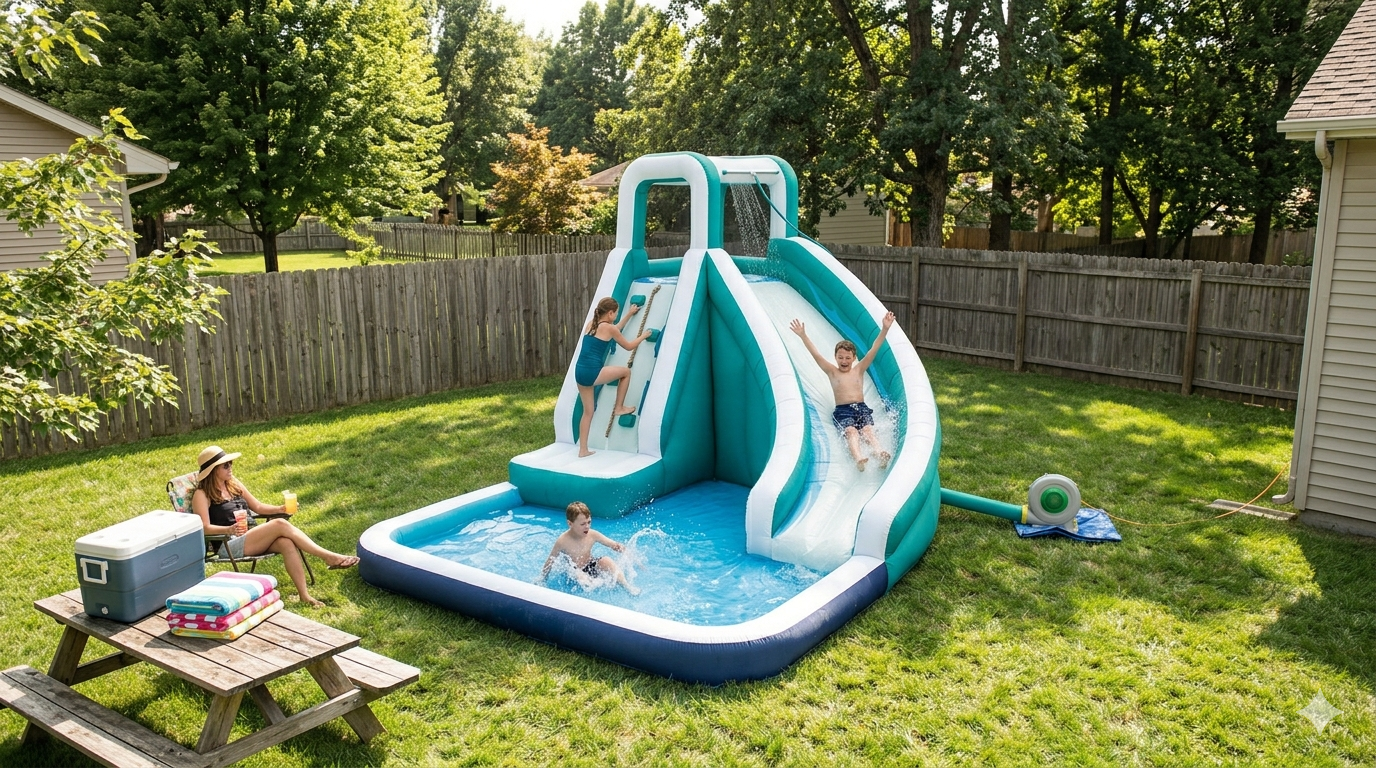
There's a difference between buying a water slide and building a backyard water park. A water slide is one inflatable that does one thing well. A water park is an experience — the right unit, the right setup, the right accessories, and a yard that's actually prepared for a full day of kids running, climbing, and splashing without anyone getting hurt or anything getting ruined.
I get a lot of questions from readers who bought a big multi-feature inflatable, set it up wrong, and ended up with a flat tire instead of a water park — a blower that couldn't keep up, anchors that pulled loose, a yard that turned into a mud pit by 2pm. This guide is meant to solve that. We'll cover which unit to buy, what accessories you actually need (and which ones are skippable), and exactly how to set the whole thing up so it survives the whole summer.
Step 1: Choose the Right Water Park Unit
The single biggest decision is which inflatable anchors your water park. There isn't one right answer — it depends on your yard size, the ages of the kids using it, and how many features you actually want versus just need.
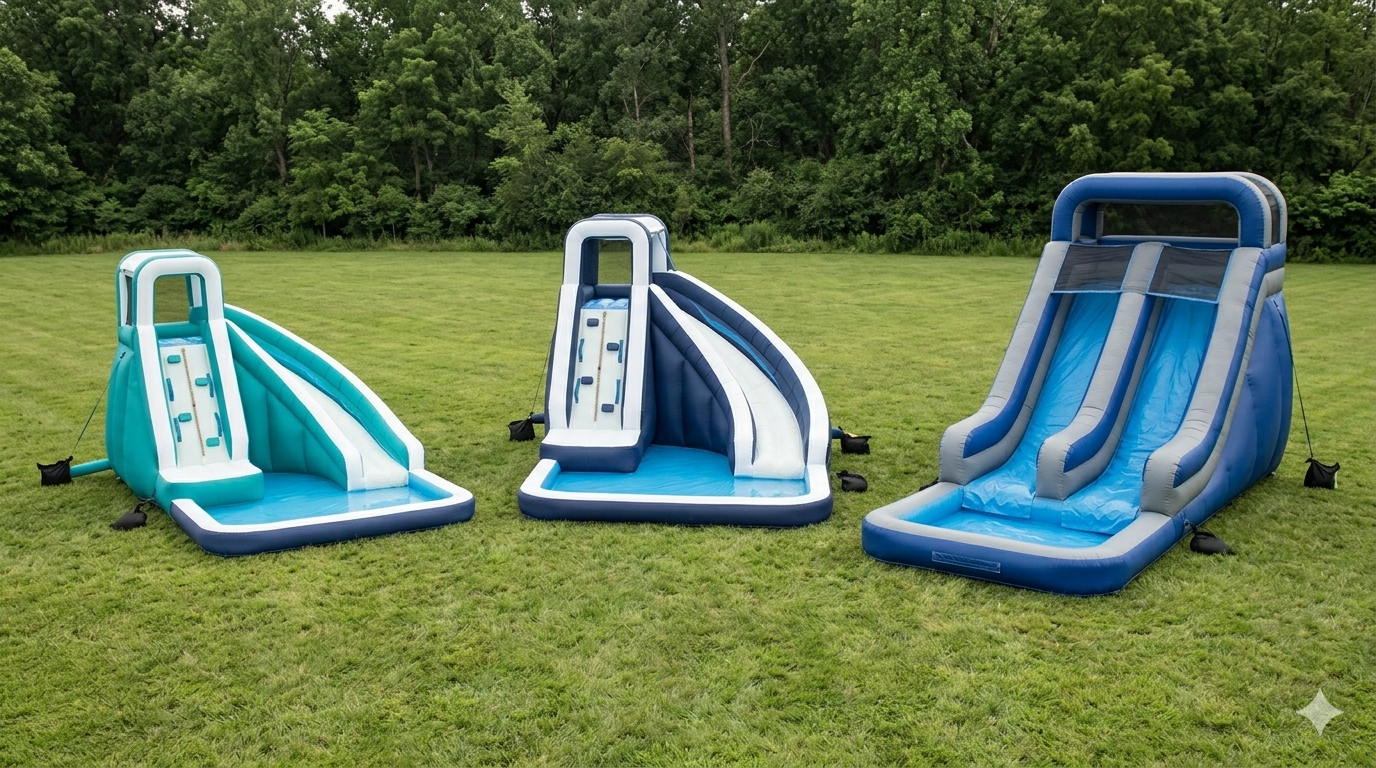
Small yards (under 20x15 feet of clear space): Look at compact units like the Blast Zone Tropical Splash. It's specifically designed to be compact and quick to set up, while still giving you a real slide and spray feature.
Medium yards, multiple kids: The Blast Zone Hydro Rush is the one I recommend most often. It's a genuine entry-level water park from a brand with the best warranty in the business, and it doesn't try to cram in so many features that durability suffers.
Bigger yards, want everything: The Blast Zone Pirate Bay and Blast Zone Shark Park both pack in a climbing wall, slide, and splash pool, and both are built on Blast Zone's commercial-grade construction. If you want one unit that does it all and will hold up for years, start here.
Mixed age groups (toddlers through pre-teens): The Banzai Twin Falls and Banzai Big Blast Water Park are designed with multiple activity zones that let different age groups find their own spot — younger kids in the splash area, older kids on the slide.
Want a different format entirely: If a single big combo unit isn't the right fit, our Best Backyard Slip and Slides guide and our Best Inflatable Water Slides guide cover standalone slide options that pair well with the accessories below.
Step 2: Get the Right Blower
This is the step people skip and regret the most. Many water park units come with a blower included, but if yours doesn't — or if the included blower is underpowered for the unit's size — you need to fix this before party day, not during it.
A weak blower means a soft, sagging inflatable that loses structural integrity throughout the day, especially as more kids climb on it and air escapes faster than it's replaced. For most residential water parks in the 12-16 foot range, you want a blower in the 480-750 watt range. For larger units like the Shark Park or Pirate Bay, step up to 950 watts or more.
My top recommendation here is the B-Air Koala 1 HP Blower. It's the most powerful residential option widely available and it's the one I'd buy if I only wanted to own one blower for multiple inflatables. For smaller units, the 450 Watt Residential Air Blower is a more budget-friendly option that still gets the job done.
One thing worth knowing: blowers need to run continuously the entire time the inflatable is in use. This isn't a "turn it on once and walk away" situation — plan your extension cord routing and outlet access accordingly, and keep the blower's air intake clear of grass clippings and debris.
Step 3: Prep the Ground Properly
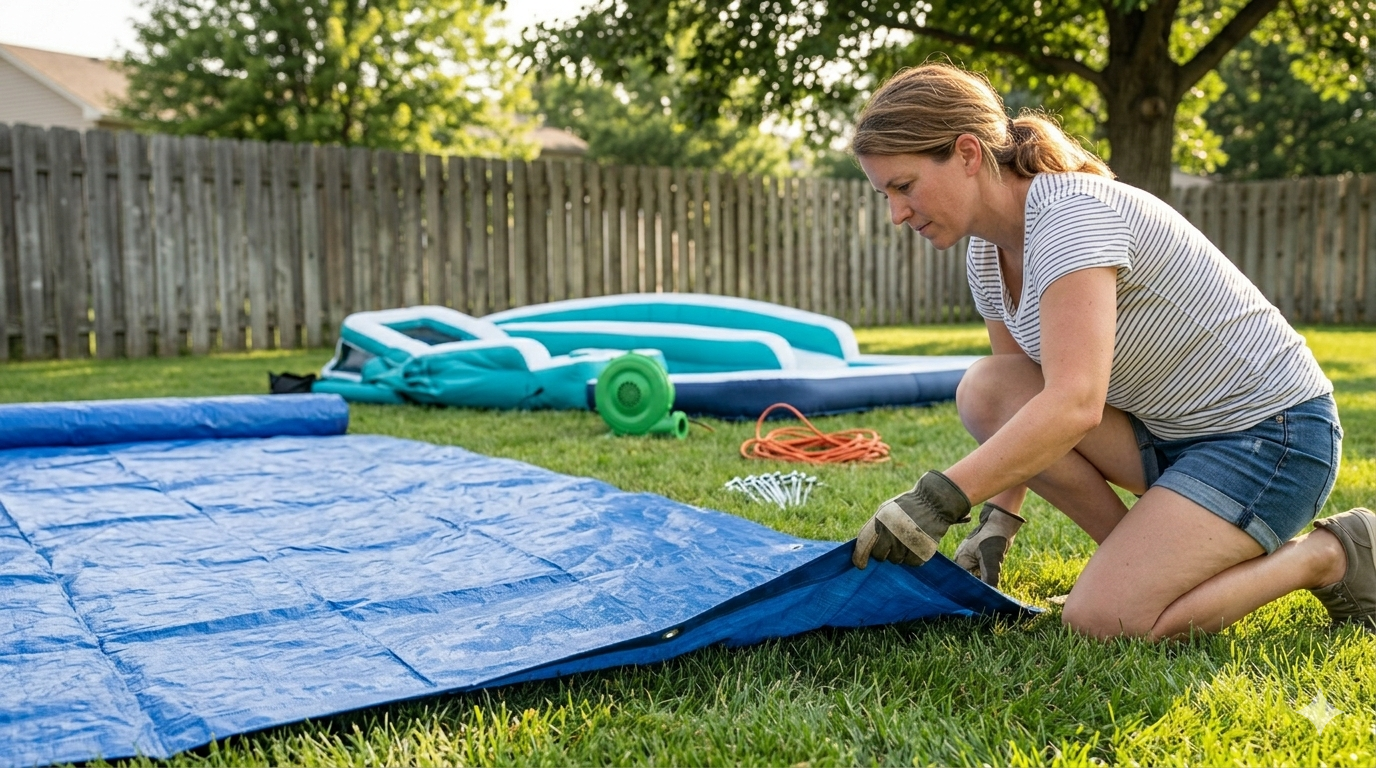
Before you unroll anything, walk the entire footprint of where the water park will sit and clear it of sticks, rocks, pinecones, and anything sharp. This takes five minutes and prevents the single most common cause of premature punctures.
Lay down a tarp underneath the inflatable before setup. This protects the bottom of the unit from ground moisture, sharp grass, and wear, and it dramatically extends the life of the inflatable floor. A 20x25 foot waterproof tarp covers most residential water park footprints with room to spare. For bigger units, the Grizzly 20x30 tarp gives you extra coverage.
Make sure the ground is as level as possible. A slight slope is fine and even helpful for drainage, but a significant grade will cause water to pool on one side of the splash pool and put uneven stress on the inflatable's seams.
Step 4: Anchor It Down — Don't Skip This
Every water park unit comes with stakes, and every single one of them needs to actually be used. A large inflatable acts like a sail in even moderate wind, and an unanchored unit can tip, shift, or roll — which is both a safety hazard and the fastest way to tear a seam.
Use every stake position the manufacturer provides, angled away from the inflatable at roughly a 45-degree angle for maximum holding power. If you're setting up on a surface where stakes won't hold well — pavement, hard clay, or a deck — supplement with sandbags instead. The Blast Zone Sandbags and the Vinyl Sand Bag 6-Pack are both solid options for this, and you genuinely cannot have too many anchor points on a large water park.
Check your anchors periodically throughout the day, especially if you notice any wind picking up. A loose stake is easy to fix in thirty seconds — a fallen inflatable with kids on it is not something you want to deal with.
Step 5: Hook Up Water the Right Way
Most water park units connect directly to a standard garden hose. A few things make this go smoothly:
Use the shortest hose run you can. Long hose runs reduce water pressure, and low pressure means weak slide flow and unimpressive splash features. If your spigot is far from the setup location, consider a wider-diameter hose to minimize pressure loss.
Check for kinks before you start. A kinked hose halfway through a birthday party is an easy problem to avoid by walking the hose length and removing twists before turning the water on.
Know your water bill impact. A water park running for several hours uses a meaningful amount of water, especially with multiple spray features. This isn't a reason not to do it, just something to budget for if you're planning a big sustained party rather than an afternoon.
Step 6: Add the Extras That Make It a Real Water Park
The inflatable itself is the centerpiece, but a few smart accessory additions are what take this from "we have a water slide" to "we have a water park."
Ball pit balls. If your unit has a ball pit area — many of the combo units do — don't skip filling it. The Intex Fun Ballz 100-pack and the Little Tikes 200-piece Ball Pit Balls are both reliable, well-reviewed options that won't leave your ball pit looking sparse.
A repair kit on standby. Even with perfect ground prep, small punctures happen eventually. Keep a Tear-Aid Vinyl Repair Kit on hand so a tiny puncture gets patched immediately instead of growing into a real problem mid-party.
Shade. Not technically part of the water park, but worth planning for. A pop-up canopy near the unit gives parents and waiting kids a place to cool off that isn't directly in the sun, especially for longer gatherings.
Towels — more than you think you need. A genuinely underrated tip: have at least one towel per kid plus a couple of spares. Wet, cold kids waiting for a towel is the fastest way to end a good water park day early.
How Much Space Do You Actually Need?
This trips people up more than anything else. Manufacturers list the inflated dimensions of the unit itself, but you need meaningfully more clear space than that:
| Unit Footprint | Clear Space Needed | Why |
|---|---|---|
| 12-15 ft | 20x18 ft minimum | Room for anchor stakes, blower, and a safe run-out zone |
| 16-19 ft | 25x22 ft minimum | Larger units need more anchor spread and clearance from fences/trees |
| 20+ ft | 30x25 ft minimum | Multi-feature units need room on every side for full stake deployment |
Add at least 5-10 feet of clearance on every side beyond the inflatable itself, and make sure there's nothing overhead — low tree branches and power lines are both real hazards that are easy to overlook when you're focused on the ground-level layout.
Safety Checklist Before Anyone Gets In
A few non-negotiables every time you set up:
Adult supervision at all times. No water park inflatable, regardless of price or brand, is designed to be used without active adult supervision.
Check the weather. Wind over roughly 20 mph is a real hazard for any large inflatable. If a storm is rolling in, deflate and take it down before it arrives — don't wait until conditions get bad.
Enforce age and weight limits. Every unit has a stated capacity. Don't treat it as a suggestion, especially with multiple kids in the splash pool or jumping area at once.
No diving or rough housing on the slide. Feet first, one at a time, no exceptions — this single rule prevents the vast majority of inflatable-related injuries.
Drain standing water daily. If you're keeping the unit set up for more than a single day, drain the splash pool each evening rather than letting water sit overnight. Standing water breeds bacteria and attracts mosquitoes fast in summer heat.
Teardown and Storage
How you put the water park away matters almost as much as how you set it up. Disconnect the water and let the unit run dry for a few minutes before deflating — this clears most of the water out of the splash pool and reduces how much moisture gets trapped inside when it's rolled up.
Once deflated, let the unit dry completely in the sun before folding and storing. Rolling up a damp inflatable is the single fastest way to grow mold inside the material, and once that happens it's very difficult to fully remove. If you're storing for the season rather than just overnight, a dry garage shelf beats a damp basement floor every time.
In Conclusion
A great backyard water park isn't just about buying the biggest inflatable you can find — it's the combination of the right unit for your space, a blower that can actually keep up, proper ground prep and anchoring, and a few smart accessories that round out the experience. Get those pieces right and you'll get years of use out of it. Skip them and you'll be dealing with a flat, torn, or wind-tossed inflatable by the second weekend.
If you're starting from scratch, my honest recommendation is the Blast Zone Hydro Rush paired with the B-Air Koala blower and a proper tarp underneath. That combination alone will get the vast majority of families a genuinely great water park experience without overspending or overbuilding for a yard that doesn't need it.