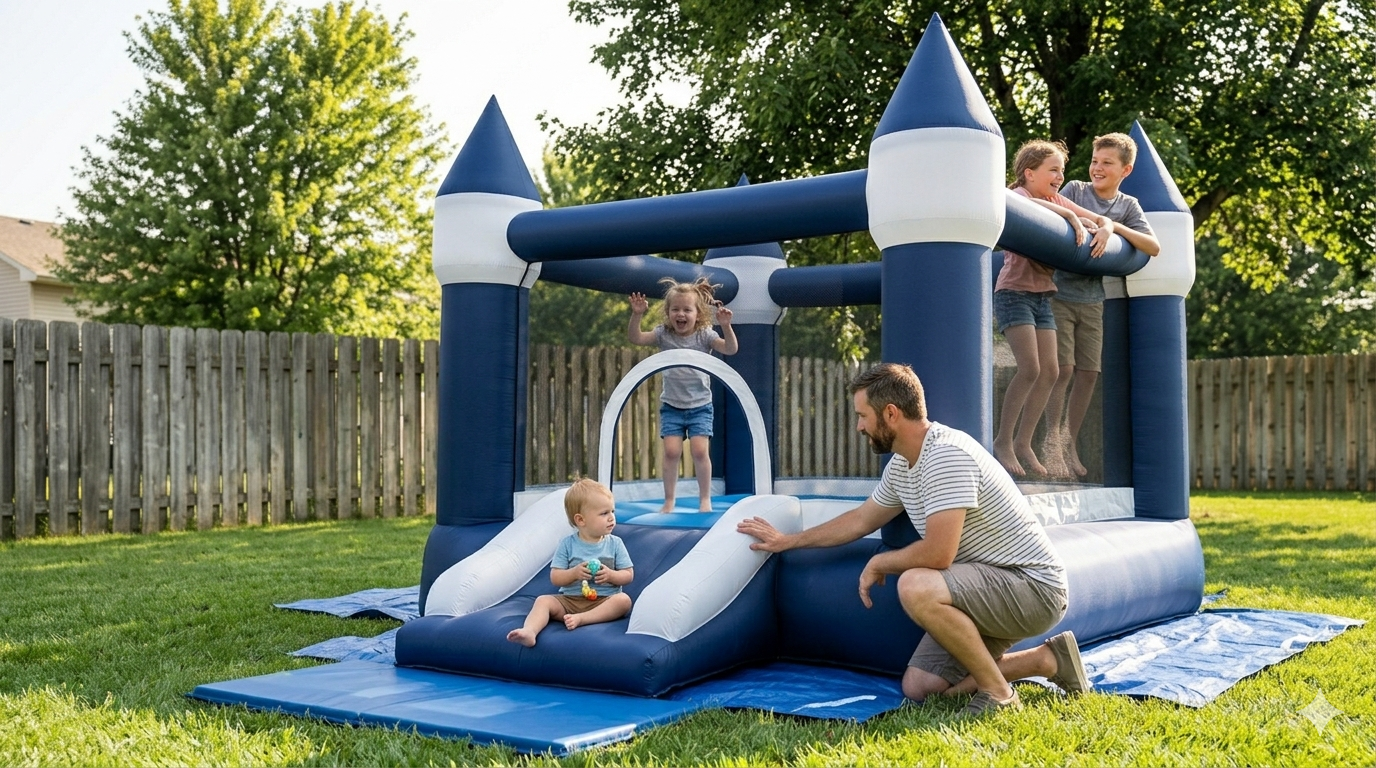
"What age is a bounce house for?" is one of the most common questions I get, and the honest answer is: it depends a lot more on the specific unit than people expect. A bounce house that's perfect for a 3-year-old can be genuinely unsafe for a 9-year-old to use at the same time, and a unit built for a backyard birthday party of 8-year-olds will bore a toddler in about ninety seconds.
This guide breaks bounce houses down by age, explains what actually matters at each stage (it's not just age — weight limits, entry height, and wall design all factor in), and points you toward specific units that are genuinely well-suited for each age range.
The Short Answer
Most bounce houses are rated for ages 3 and up, with most manufacturers setting a 90-130 lb weight limit per child and a combined weight limit for the whole unit somewhere between 200 and 400 lbs depending on size. But "rated for ages 3 and up" doesn't mean every 3-year-old should be in there with a group of 8-year-olds — age range and safe age range are two different things, and that distinction is what this guide is really about.
Bounce Houses by Age: The Full Breakdown
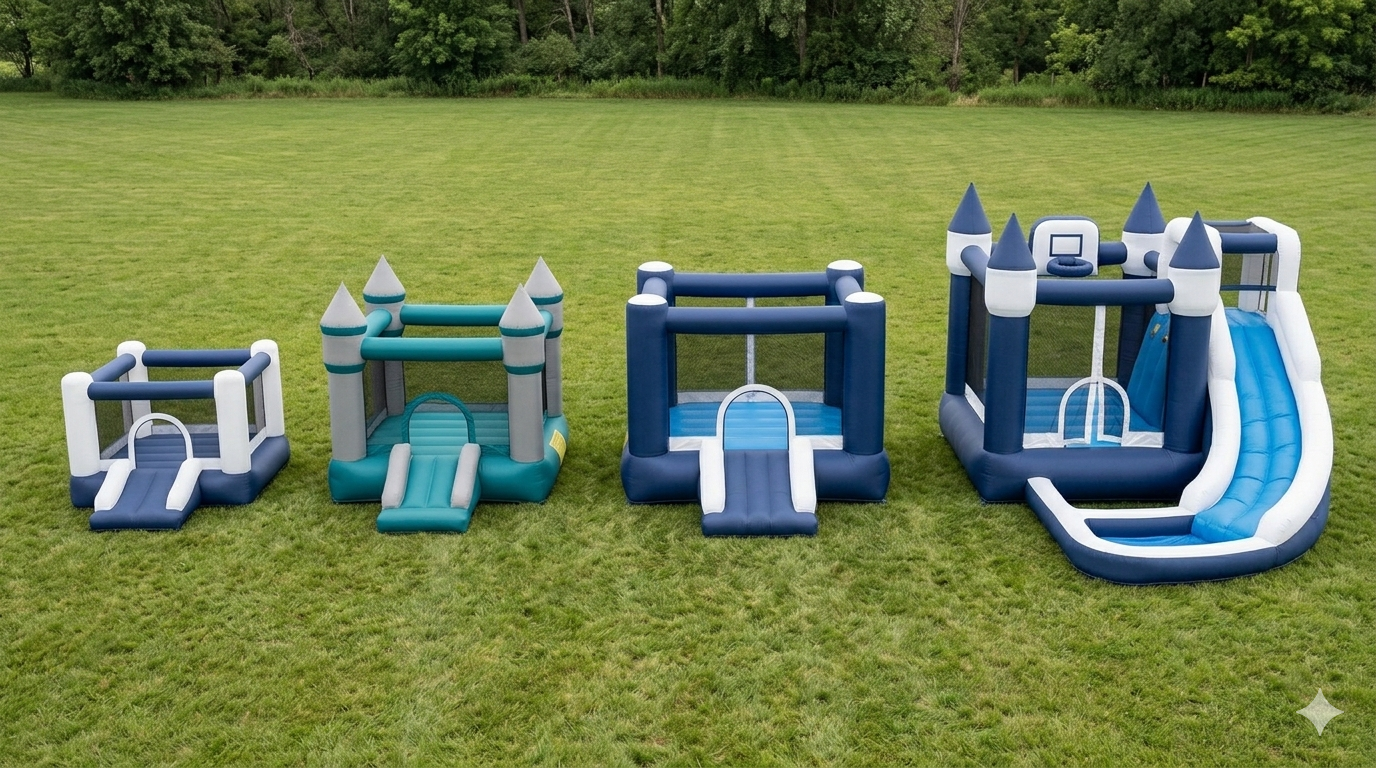
Ages 1-2: Proceed with Caution
Most standard bounce houses are not designed for kids this young, and for good reason — toddlers under 2 don't have the balance or body awareness to bounce safely, especially around other kids. If you want to introduce a very young child to bouncing, look specifically for units designed for this age range rather than putting them in a standard bounce house.
The Fisher-Price Bouncetastic Bouncer is one of the few units genuinely designed for kids just starting to walk and jump — it's low to the ground, fully enclosed, and includes a ball pit, which gives very young kids something to do besides just bouncing. Even with a unit like this, supervision should be constant and hands-on, not just watching from a lawn chair.
Ages 2-4: Toddler-Specific Units
This is where dedicated toddler bounce houses come in, and it's worth buying one specifically designed for this age range rather than a "for ages 3 and up" general unit. The differences that matter: a low entry point a small child can climb through independently, a smaller overall jumping surface, and a lower weight limit that keeps bigger kids out by design.
The Blast Zone Little Bopper is my top recommendation for this age range — it's compact, well-built, and backed by Blast Zone's two-year warranty. The Little Tikes Dunk N Toss is a great alternative if you want a unit with a basketball hoop and toss game to add some variety. For a full breakdown of options at this stage, see our complete guide to bounce houses for toddlers.
Ages 4-6: Stepping Up to a Slide
By this age, most kids are ready for a slightly larger unit, and this is usually when a slide enters the picture. Kids in this range have the coordination to climb and slide safely, and the added feature tends to hold their attention much longer than a pure bouncer.
The Little Tikes Jump 'n Slide Bouncer is the standard recommendation here — it's affordable, widely available, and sized appropriately for this range. If you want something with more durability and a longer warranty, the Blast Zone Magic Castle is a step up in build quality at a similar size.
Ages 6-9: Full-Size Bounce Houses
This is the age range most "standard" backyard bounce houses are actually built for. Kids in this range are strong enough to handle a full-size jumping surface, taller walls, and a real entry climb without assistance. This is also the age where group play really starts working — multiple kids bouncing together, which is part of why most rental-style units are sized for this range.
The Bounceland Royal Palace Inflatable Bounce House is a great fit here, with enough room for several kids and a slide to keep things interesting. If you're hosting parties regularly and want something built to handle heavier repeated use, this is also the age range where it's worth considering a step up to commercial-grade construction — see our best bounce house brands guide for the full rundown on what separates residential from commercial units.
Ages 9-12: Bigger Units, Mixed Groups
Pre-teens are heavier, more aggressive jumpers, and usually want to bounce in bigger groups — birthday parties at this age often mean 6-10 kids using the unit at once. This is where weight limits become a genuinely important factor to check before buying, not just a fine-print detail.
Look for units with a higher combined weight capacity, reinforced jumping surfaces, and — if you're hosting groups regularly — consider an obstacle course style unit for variety. The JumpOrange Commercial Grade 30' Rainbow Xtreme Obstacle Course is a great option if you want something that keeps a group of pre-teens engaged for hours rather than just bouncing in place.
Teens and Adults
Yes, bounce houses for teens and adults are a real category, and the demand is higher than you might expect — think graduation parties, family reunions, and the increasingly popular "adult bounce house party" trend. The key factors here are weight capacity (look for units rated for 250+ lbs per person) and reinforced commercial-grade construction, since adult body weight puts meaningfully more stress on seams and jumping surfaces than kids do.
Commercial-grade units — the kind built for party rental businesses — are generally the safest bet for adult use. If teens or adults want the bouncing experience without the size and setup of a full unit, a backyard trampoline is often a more practical alternative.
Mixed-Age Groups: What to Watch For
The question I get almost as often as "what age is this for" is "can my toddler and my 8-year-old use it together." The honest answer is: not safely, in most cases, and here's why.
The double-bounce effect. When a heavier child lands near a lighter child, the lighter child can get launched higher and less predictably than they would bouncing alone. This is the single biggest mixed-age safety issue, and it's the reason most bounce house manufacturers explicitly warn against mixing significantly different sizes of kids in the same unit at the same time.
The fix is simple: stagger by age group. Let toddlers and very young kids bounce first, in a smaller group, with close supervision. Then let older kids take a turn separately. It's not as fun as everyone bouncing together, but it's significantly safer, and most kids adjust to the rotation quickly once it becomes the normal routine.
If you genuinely need one unit for a wide age range at the same event, look for bounce houses with multiple separated zones — a toddler-friendly area, a separate bouncing area, and a slide — like the combo units featured in our backyard water park setup guide. Separated zones naturally keep different age groups from colliding with each other.
Weight Limits: What the Numbers Actually Mean
Every bounce house lists two different weight numbers, and it's worth understanding the difference:
Per-child weight limit. This is the maximum weight for any single child using the unit, usually somewhere between 90 and 150 lbs depending on the unit's size and target age range.
Combined weight limit. This is the maximum total weight of everyone in the unit at once, typically 200-400 lbs for residential units. This number matters more than people realize — a unit rated for "4 kids" assumes those 4 kids are within the target age range. Four 10-year-olds can easily exceed a combined limit that was calculated assuming younger, lighter kids.
When in doubt, count heads conservatively and err on the side of fewer kids at once, especially for units on the smaller end of their size category.
A Quick Reference Table
| Age Range | What to Look For | Recommended Unit |
|---|---|---|
| 1-2 years | Low entry, fully enclosed, ball pit feature | Fisher-Price Bouncetastic Bouncer with 50 Play Balls, 69" x 68" x 53" |
| 2-4 years | Toddler-specific sizing, low weight limit, compact | Blast Zone Little Bopper |
| 4-6 years | Adds a slide, moderate size, still beginner-friendly | Little Tikes Jump 'n Slide Bouncer Plus Heavy Duty Blower |
| 6-9 years | Full-size jumping area, taller walls, group capacity | Bounceland Royal Palace Inflatable Bounce House |
| 9-12 years | Higher weight capacity, reinforced construction, activity variety | JumpOrange Commercial Grade 30' Rainbow Xtreme Inflatable Obstacle Course, Red/Yellow/Blue |
| Teens / Adults | Commercial-grade build, 250+ lb per-person rating | See commercial-grade options |
In Conclusion
The right bounce house age range isn't a single number — it's a combination of your child's age, weight, and whether they'll be bouncing alone or with a mixed group. Buy for the age and stage your kids are actually at right now rather than sizing up "to grow into," since an oversized unit can be just as unsafe for a small child as an undersized one is unsatisfying for a bigger kid.
If you're still narrowing down a specific unit, our ultimate bounce house buying guide walks through the full purchasing decision in more depth, and our brand rankings will help you avoid the lesser-known names that tend to disappoint.